
Laki Syyttäjälaitoksesta (32/2019), 2 luku 10 § — Syyttäjän toimivalta
Laki Syyttäjälaitoksesta 32/2019, 2 luvun 10 §:n suomenkielinen teksti ja epävirallinen englanninkielinen käännös syyttäjän itsenäisestä ja riippumattomasta syyteharkinnasta.
Laki Syyttäjälaitoksesta (32/2019), 2 luku 9 § — Syyttäjän tehtävät
Laki Syyttäjälaitoksesta 32/2019, 2 luvun 9 §:n suomenkielinen teksti ja epävirallinen englanninkielinen käännös syyttäjän tehtävistä.
Laki oikeudenkäynnin julkisuudesta yleisissä tuomioistuimissa (370/2007), 11 § — Salassapitoaika
Lain 370/2007 11 §:n ajantasainen suomenkielinen teksti ja epävirallinen englanninkielinen käännös salassapitoajoista.
Suomen perustuslaki (731/1999), 21 § — Oikeusturva
Suomen perustuslain 21 §:n alkuperäinen teksti, epävirallinen englanninkielinen käännös ja selitys oikeusturvasta.
Esitutkintalaki (805/2011), 4 luku 5 § — Vähimmän haitan periaate
Esitutkintalain 4 luvun 5 § suomeksi, epävirallinen englanninkielinen käännös ja selitys.
Esitutkintalaki (805/2011), 4 luku 4 § — Suhteellisuusperiaate
Esitutkintalain 4 luvun 4 § suomeksi, epävirallinen englanninkielinen käännös ja selitys.
Esitutkintalaki (805/2011), 4 luku 3 § — Oikeus olla myötävaikuttamatta rikoksensa selvittämiseen
Esitutkintalain 4 luvun 3 § suomeksi, epävirallinen englanninkielinen käännös ja selitys.
Esitutkintalaki (805/2011), 4 luku 2 § — Syyttömyysolettama
Esitutkintalain 4 luvun 2 §:n alkuperäinen suomenkielinen teksti ja epävirallinen englanninkielinen käännös. Lähde: Finlex.
Esitutkintalaki (805/2011), 4 luku 1 § — Tasapuolisuusperiaate

Esitutkintalain 4 luvun 1 §:n alkuperäinen suomenkielinen teksti ja epävirallinen englanninkielinen käännös. Lähde: Finlex.
The Gifted Finnish Investigator
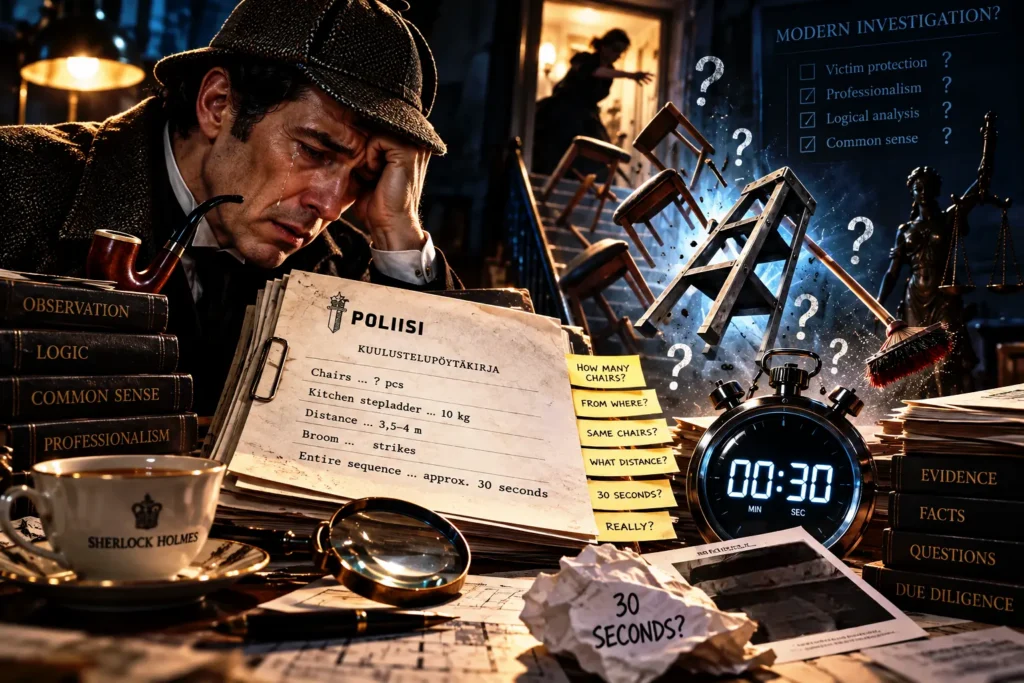
The Gifted Finnish Investigator Thirty Seconds, the Wrong Time, and the Mystery Photograph How does a person initially treated as the injured party become a suspect in the same case? In the Victim–Suspect Flip Case (R 706/2025/5226), that question leads back to the pre-trial investigation, the account available to the investigator, the stated time of the incident, and the evidence used to support the counter-allegation against TG. This is a documentary audit of the investigative process. It begins with the account that was available before trial and asks what was verified, what remained unexplained, and what the case file actually establishes. How to Create a Counter-Allegation Without Investigating It Four additional questions were appended to the interrogation. Four questions — and the case remained open. TG was initially questioned at the police station as the injured party in the assault reported on 29 December 2023. On 24 April 2024, the interrogation record contains a pre-printed statement that TG had been informed of her rights and was being questioned as a suspect. But where is the recorded exchange establishing that this change of procedural status was explained to her? Where is the question confirming that she understood the change? And where did TG state that she agreed to proceed without a lawyer? The document contains the standard formula. It contains no recorded answers establishing TG’s understanding of the change in status or her decision concerning legal assistance. Then came the next seventeen months and seven days before trial. What, exactly, happened during that time? Where is the documented investigative work? Where are the additional witness interrogations? Where are the newly collected items of evidence? Where is the documented verification of the competing accounts? Where is the record of an investigative visit to the scene? In the materials available for this audit, no such investigative steps have been identified. The interrogation record documents the allegations put to TG and her denials. Yet the central allegation against her raises elementary questions about the sequence of events, the position of the people involved, the alleged object, and whether the described actions could have occurred as claimed. Those questions called for investigation, not merely another set of questions appended to an interrogation record. One year, five months, and seven days is a substantial amount of time. What was it used for? The available materials show the counter-allegation being pursued. Where is the documented work that tested it? Where are the records of further evidence collection, witness interviews, or examination of the scene? What investigative foundation supported the counter-allegation as the case proceeded towards trial? This is the investigator’s peculiar achievement, as the documents examined here present it: a counter-allegation was pursued, but the record contains no identified investigative steps demonstrating how its factual basis was tested. Four questions added at the end. An open case. One year, five months, and seven days before trial. A remarkably long interval — and remarkably little documented investigative activity in the materials examined. The question is not simply why TG became a suspect. It is what, if anything, the documented investigation established about whether the accusation against her was true. What, exactly, did the investigator accept as evidence? The photograph shows a small, localised discolouration on a section of skin. It does not show a face. It does not show the entire leg. The anatomical orientation is not independently established by the image alone. The photograph itself does not establish whose body part is depicted, when the mark appeared, or what caused it. Yet the allegation concerned a specific person, a specific incident, a specific object, and a specific anatomical location. A photograph of a mark is one thing. Proof that the mark belonged to N, resulted from the alleged incident, and was caused by TG is quite another. The Criminal Investigation Act requires the circumstances of the suspected offence to be clarified and evidence both against and in favour of a suspect to be considered. So the question is straightforward: What independently established facts connected this unidentified section of skin to the alleged assault by TG? A label is not an identification method. An allegation is not proof of causation. And a photograph cannot answer questions that it does not actually show. Two Scratches and an unidentified body part Let us look at the photograph itself. Where is the face? Where is the foot? Where is the knee, or any other anatomical landmark that would allow the viewer to establish whether the image shows a thigh or a lower leg? Where is the rest of the body? The photograph presents only a small fragment of skin with a couple of superficial-looking marks. From the image alone, the person cannot be identified, the exact anatomical location cannot be established with confidence, and the origin of the marks cannot be determined. There is no visible identifier connecting this fragment of a body to N. There is no visible evidence establishing when the marks appeared, what caused them, or whether they resulted from the alleged incident. And yet this image became part of the case against TG. What, precisely, was the investigator able to establish from this photograph? Not whose body part it was. Not the exact location of the marks. Not their origin. Not their connection to the alleged act. The photograph does not answer those questions. Our opinion is straightforward: this image cannot, by itself, establish the facts required to prove the allegation against TG. Treating it as if it did would mean substituting an assumption for identification, and an unexplained mark for proof of a specific act. The Neighbour’s Bruise Method Taken to its absurd conclusion, this approach would make almost anyone a potential criminal. One could obtain a photograph of an unidentified patch of skin, take it to the police, and claim that it showed an injury caused by a particular person. If nobody established whose body part appeared in the image or what the marks had to do with the alleged event, the accusation