
Case Reference: R 706/2025/5226

Official Demands Submitted on: April 23, 2026 (01:54 AM & 10:13 AM)
Jurisdiction: Helsinki Court of Appeal (Helsingin hovioikeus)
On April 23, 2026, two official applications were filed to the Helsinki Court of Appeal to strip the classified status from vital evidence, secure trial records, and correct severe procedural errors that compromise the presumption of innocence and the principle of equality of arms (Article 6 of the ECHR).
The defense demands the immediate release of:
This staggering 23-month gap of total judicial freeze is a direct violation of Article 6 of the ECHR regarding the right to a hearing within a reasonable time. The defense has a strict legal right to receive a formal explanation for this systemic delay and an official confirmation of the schedule.
A systematic audit of Case R 706/2025/5226 reveals a catastrophic breakdown of judicial integrity across ten distinct dimensions. Each point below represents an indefensible departure from the standard of proof, in dubio pro reo, and the reliability of evidence:
Thomas Paine (Common Sense):
“In America [and in a true state of law], the law is king. For as in absolute governments the king is law, so in free countries the law ought to be king; and there ought to be no other.”
When a judicial proceeding collapses under ten independent pillars of physical, technical, and procedural fraud, the verdict is legally void.
Time passed since the official ECHR Art. 6 evidence release demand was sent.
Court of Appeal Silence: A rigorous forensic audit of Case R 706/2025/5226 exposes direct, systematic violations of core legal frameworks anchored in the Constitution of Finland, the Code of Judicial Procedure (Oikeudenkäymiskaari), and foundational European human rights standards. These systemic failures map directly to specific legal breaches:
Legal Framework: Section 21 of the Constitution of Finland (731/1999) & Article 6 of the European Convention on Human Rights (ECHR).
Violations in the Audit:
Edmund Burke:
“Law and arbitrary power are in eternal enmity.”
When domestic procedure collides with constitutional protections, formal documentation is mandatory.
Legal Framework: Chapter 11 and Chapter 17 of the Code of Judicial Procedure (4/1734), alongside constitutional guarantees of fair criminal procedure.
Violations in the Audit:
Aristotle:
“The rule of law is better than the rule of any individual.”
When courts replace proof beyond a reasonable doubt with speculative probability, statutory protections become fiction.
Legal Framework: Chapter 17 of the Code of Judicial Procedure (4/1734), governing evidence rules in Finnish courts. While judges possess procedural discretion in weighing evidence, that discretion is strictly and legally bound by logic, objective physics, and material truth.
Violations in the Audit:
Plato / Pindar (The rule of law):
“Law is king of all, mortals and immortals alike.”
When discretionary evidence evaluation degrades into anatomical and textual fabrication, the entire judicial edifice collapses.
Legal Framework: Statutory procedural requirements governing the absolute integrity, verifiability, and transparency of official court protocols and digital archives.
Violations in the Audit:
5495FBB7 vs. D125A37A) violates the core judicial obligation to maintain an authentic, verifiable, and untampered trial record, destroying the reliability of evidence.Cicero:
“We are bound by the law so that we may be free.”
When digital checksums corrupt and half a trial vanishes, the institutional record is legally void.
As you may already know, the grandmother faced charges built on a clear physical impossibility. Hoping to correct the situation, she appealed to a higher authority, believing the system would set straight its young and inexperienced prosecutor. She reasonably expected a basic professional review and staff retraining, but instead received a wall of institutional protection and an official cover-up. The system closed ranks to shield its rookie, transforming procedural absurdity into an authorized standard. This cynical response is what we are exposing and analysing on this page.
The Absurdity of a “Mutual Fight”:
The prosecutor (Tomas Niemitalo) fabricated a narrative of a mutual fight, ignoring the glaring reality of a grandmother supposedly battling a 37-year-old man in the early morning hours while simply waiting for his headphones to run out of battery.
Breach of Objectivity:
The prosecutor violated the statutory principle of objectivity (objektiivisuusperiaate) by swallowing the shifting, contradictory lies of the domestic abuser whole, while completely ignoring police crime scene photos and objective facts.
Fabricated Charges & Physical Impossibility:
Charges were filed for allegedly throwing a heavy ten-kilogram oak-and-metal stepladder and a street broom – actions proven to be an absolute physical impossibility given the room’s layout (doorways and cat trees), and backed by a complete absence of fingerprints, DNA, or marks.
Ignored Contradictions and Alternative Explanations:
The prosecution brushed aside the abuser’s admission that he never saw who threw the items, ignored his conflicting statements between pre-trial and court, and glossed over the fact that his wife (with whom he was fighting) was right there in the apartment.
The Phantom Photographic Artifact:
The core “evidence” used to convict consists of an unverified photo of a minor bruise, completely stripped of metadata and disconnected from any real event.
Downplaying Real Violence and Threats:
The prosecutor completely ignored the abuser’s direct death threats (“Die!”) and physical assault with an iron pipe against the grandmother, while trivializing severe head trauma that resulted in a bloody nose.
Rewarding Flight:
The abuser fled the scene the moment police were called, yet the system treated him like a victim while punishing the grandmother who stayed.
Administrative and Personal Toll:
The sheer negligence of this prosecution forced the grandmother to endure heavy financial costs, severe stress, reputational damage, and an agonizing wait for an appeal in 2027.
Collateral Trauma to a Child:
Because of this manufactured conviction, the grandmother is forced to call her grandchild – who lives in the same household as the abuser – as a witness in 2027, exposing the child to deep psychological trauma.
Core Demands: A formal investigation into the prosecutor’s professional ethics and a binding ruling on how filing baseless charges without a shred of evidence can ever align with the principle of objectivity.
When institutional self-preservation shields rookie misconduct and ignores physical laws, independent forensic documentation remains the only defence against systemic injustice.
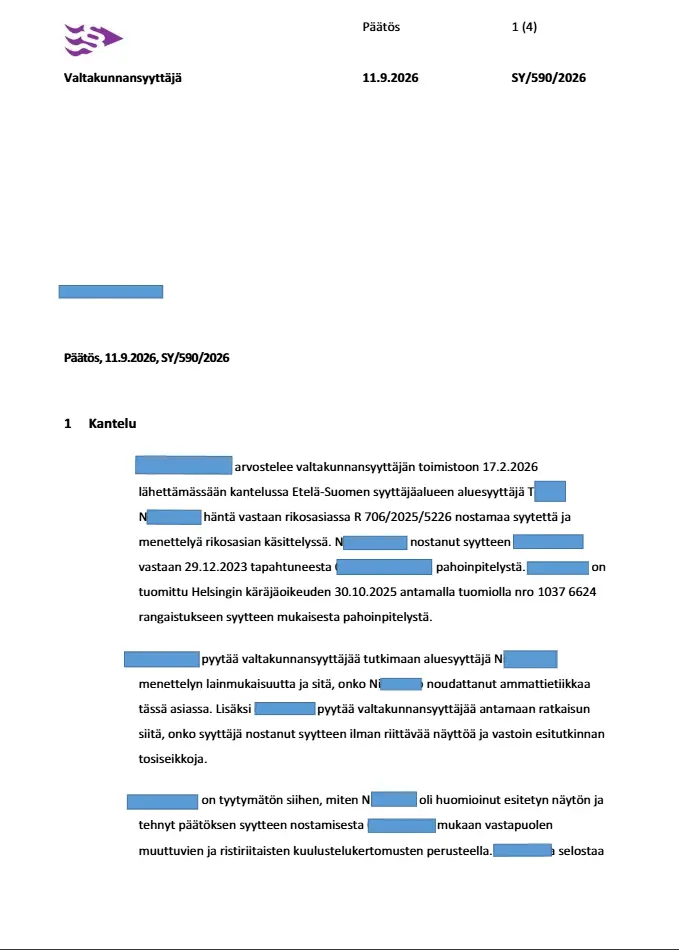
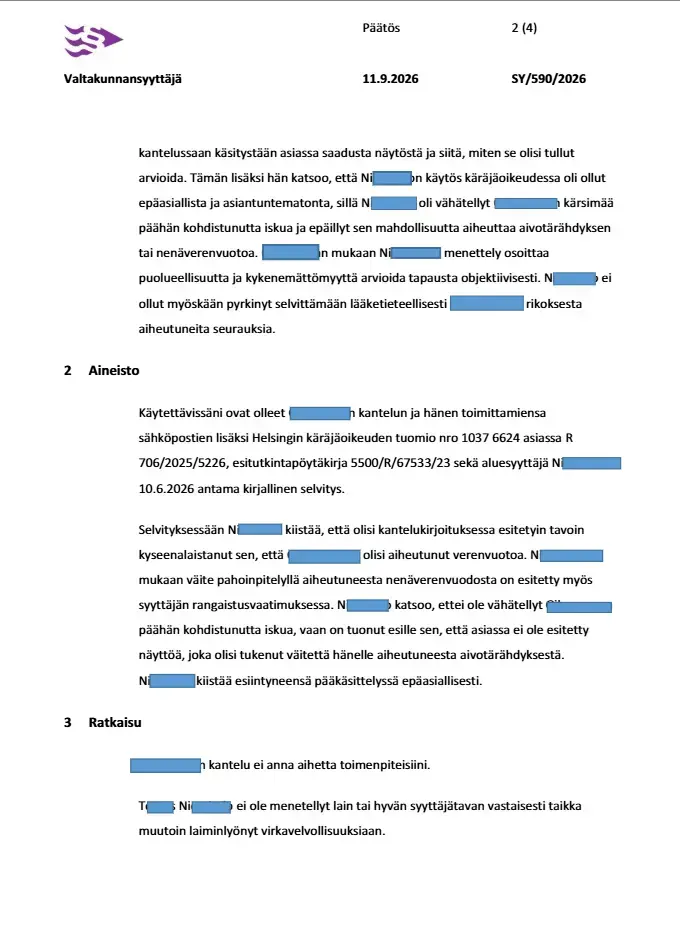
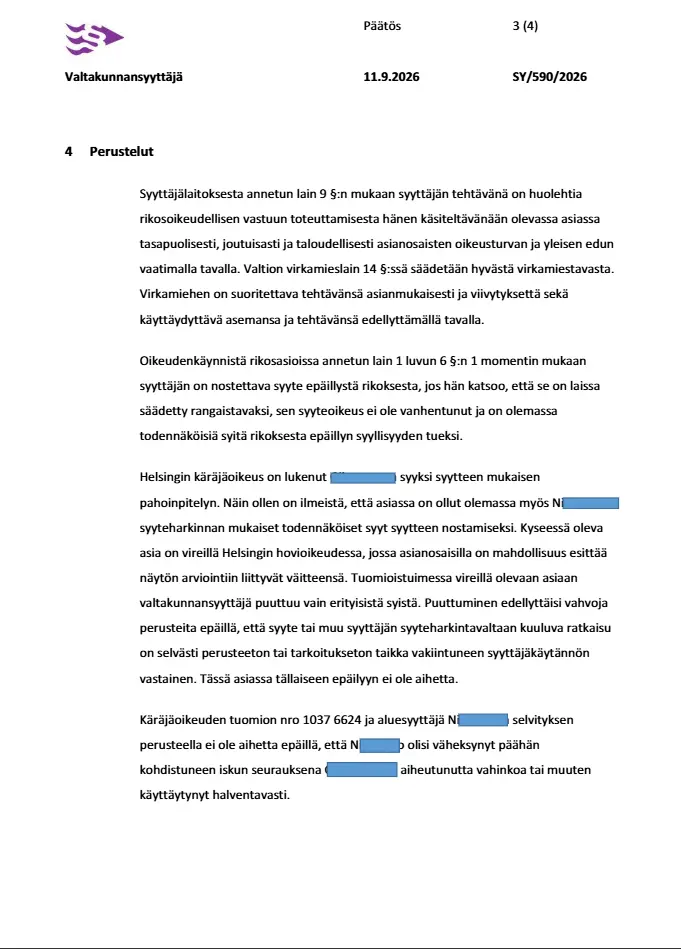
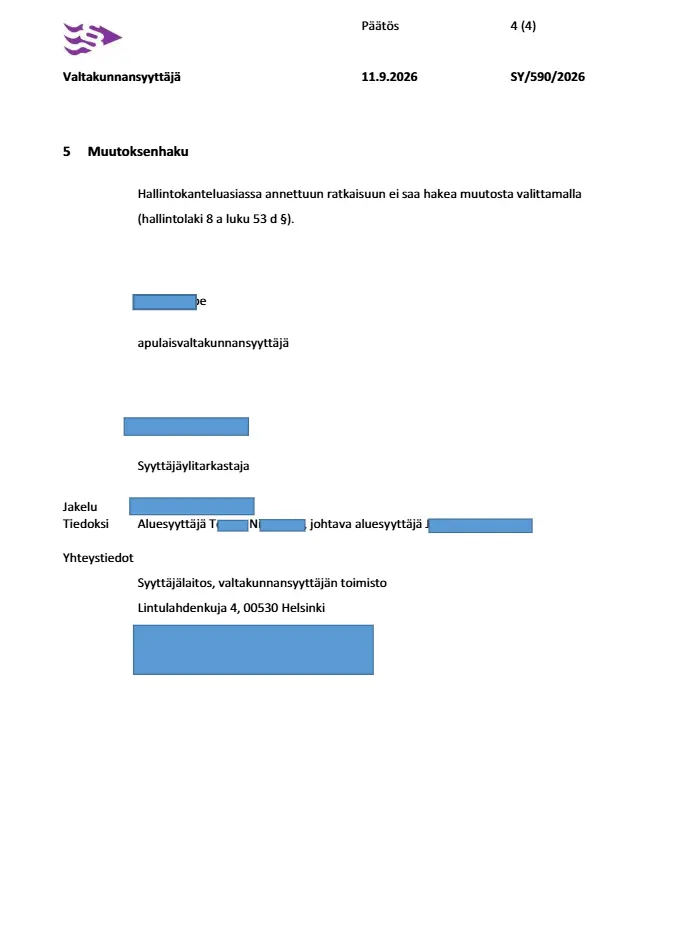
When the formal complaint detailing the complete absence of evidence, the phantom injuries, and the physical impossibility of throwing a ten-kilogram oak-and-metal stepladder reached the Office of the Prosecutor General (Valtakunnansyyttäjä), the response on September 11, 2026, delivered a masterclass in institutional evasion.
The reviewing authority reviewed the file – including the crime scene documentation – and concluded that prosecutor Tomas Niemitalo committed no error. But this official stamp of approval raises a chilling question that exposes the mechanics of complicity:
The Physics Test:
Anyone examining the spatial layout, doorway dimensions, and physical obstacles captured in the police photographs can see within two seconds that a 37-year-old man and a grandmother could not execute the alleged violent scenario, let alone project a heavy ladder across the room. A dead fly couldn’t clear those obstacles under the described conditions.
The Threshold of Complicity:
When a supervisory body is explicitly presented with objective proof of a physical impossibility – and chooses to look away to shield a junior prosecutor – does that administrative protection morph into an accessory act?
Sanctioning the Absurd:
By ruling that a prosecution built entirely out of an evidentiary vacuum and contradicted by the laws of physics requires no intervention, the Office of the Prosecutor General effectively establishes a dangerous precedent: administrative convenience outweighs biological and spatial reality.
The system was given a clear choice: correct an obvious rookie error and restore professional standards. Instead, it chose to institutionalize the fiction, proving that when a fabricated case is challenged, the upper echelons will protect the error rather than admit the truth.
Listen to the complete audio investigation as we draw the historical line from the 1819 Boorn brothers show trial straight into the modern evidentiary vacuum of The Victim-Criminal Flip Case R706/2025/5226, Finland. Discover how physical impossibilities, 100-year state secrecy stamps, and institutional cover-ups undermine the very core of judicial integrity.
LawBeat Radio
Independent legal media platform focusing on structural judicial monitoring and criminal case analysis. We examine international standards of justice, from the presumption of innocence to the rigorous evaluation of the standard of proof and in dubio pro reo principles.
Legal Disclaimer:
All analytical materials and legal case reviews on this website are published for informational and educational purposes only under freedom of expression. Content does not constitute professional legal advice.
© 2026 LawBeatRadio. All rights reserved.