
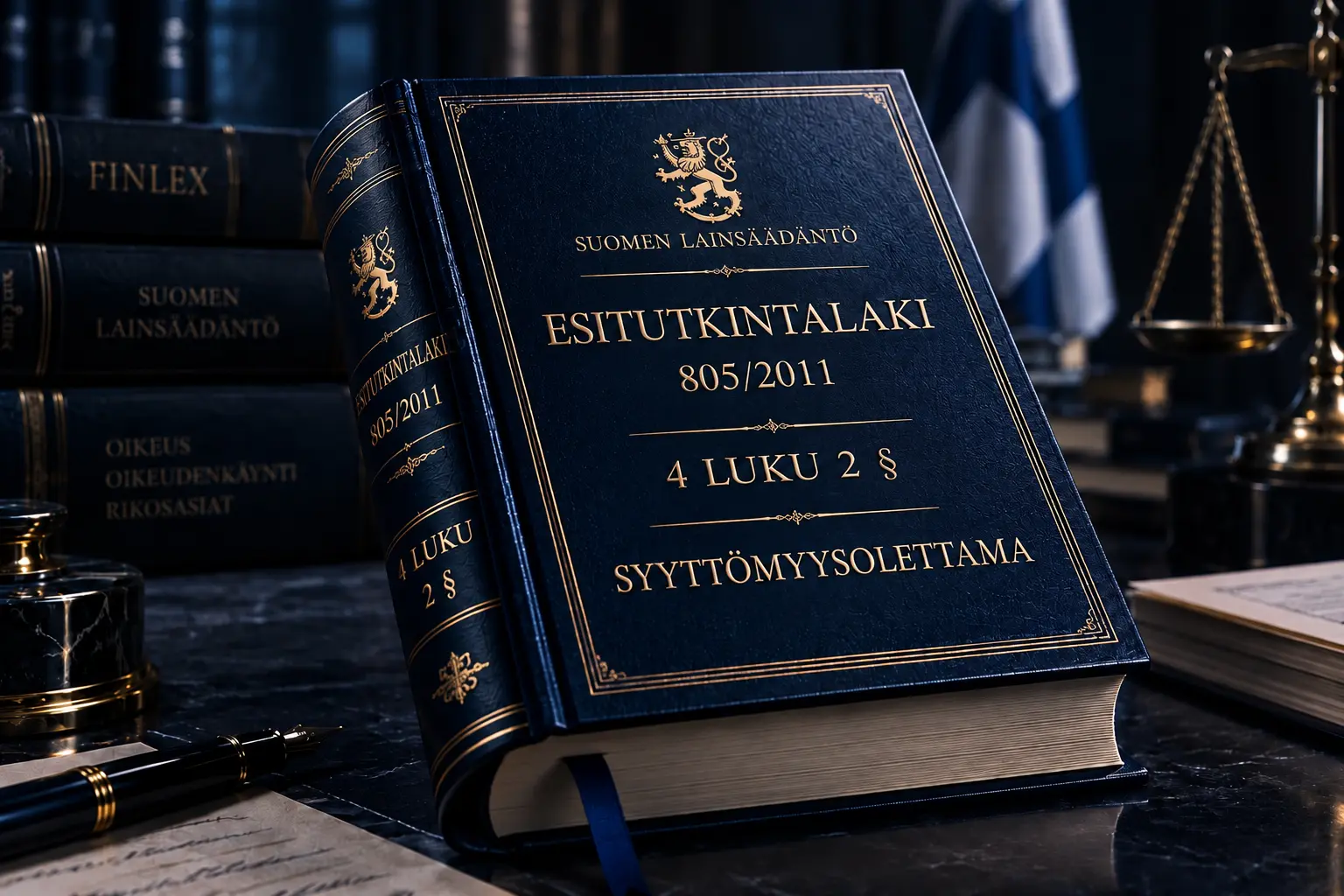
Esitutkintalaki (805/2011), 4 luku 2 § — Syyttömyysolettama
Rikoksesta epäiltyä on kohdeltava esitutkinnassa syyttömänä.
A person suspected of an offence must be treated as innocent during the criminal investigation.
This English translation is unofficial and provided for informational purposes. The Finnish statutory text is authoritative.
The distinction is between investigating a suspicion and treating the suspicion as an established fact.
Esitutkinnassa on selvitettävä ja otettava huomioon sekä rikoksesta epäiltyä vastaan että hänen puolestaan vaikuttavat seikat ja todisteet.Unofficial English translation:
During a pre-trial investigation, circumstances and evidence both for and against the suspect must be investigated and taken into account.These two provisions address related but distinct obligations. The presumption of innocence governs how the suspect must be treated. The impartiality principle requires the investigation to consider both incriminating and exculpatory circumstances. In a procedural audit, the second provision may be especially relevant where an investigation appears to have concentrated on evidence supporting one account while failing to examine material that could contradict it. The omission of an investigative step does not automatically establish a breach. The relevant questions include what information was available, what was requested or overlooked, why it mattered and whether the investigation adequately addressed it.
Court: Supreme Court of Finland
Subject: Presumption of innocence and reporting on a pending criminal matter
In KKO 2013:100, published by Finlex, the Supreme Court considered the relationship between the presumption of innocence and media reporting about a criminal matter that was still at the pre-trial investigation stage. The Court explained that the presumption of innocence does not prohibit reporting on an ongoing investigation. However, reporting must take account of the fact that the matter remains unresolved. The wording and overall presentation must be assessed in context.Practical example: A statement that a person is suspected of an offence communicates the procedural status of the matter. A statement that the person committed the offence presents guilt as an established fact. The precise wording, context and status of the proceedings matter when assessing whether the presumption of innocence has been respected.
Court: European Court of Human Rights
Application no.: 15175/89
Judgment: 10 February 1995
In Allenet de Ribemont v. France, HUDOC, senior police officials publicly described the applicant as involved in a murder while the criminal investigation was ongoing. The European Court of Human Rights held that the presumption of innocence may be violated not only by a court but also by other public authorities. Authorities may inform the public about an investigation, but they must exercise the necessary discretion and restraint.The decision concerned public statements by officials, rather than the specific conduct of an entire investigation. Its relevance to an investigation audit lies in the broader principle that public authorities must not treat an unresolved allegation as proven guilt.
Court: Supreme Court of Finland
Subject: Evaluation of evidence and the presumption of innocence
In KKO 2018:3, published by Finlex, the defendant was accused of a drug offence after a postal item containing amphetamine had arrived from abroad in the defendant’s name and at the defendant’s address. The defendant denied ordering the item or knowing about it. The Supreme Court concluded that a reasonable doubt remained concerning the defendant’s guilt and rejected the charge.This decision concerns the assessment of evidence in criminal proceedings rather than the direct application of the investigation-stage wording of Section 4, Chapter 2. It nevertheless illustrates the closely related principle that guilt must be established through evidence, not assumed from suspicion alone.
The presumption of innocence requires public authorities to preserve the distinction between suspicion and established guilt. At the investigation stage, this principle must be considered alongside the obligation to investigate both incriminating and exculpatory circumstances.
For a procedural audit, the central task is to examine what the record actually establishes, what remains disputed and whether the investigative reasoning adequately addresses the evidence on both sides.
LawBeat Radio
Independent legal media platform focusing on structural judicial monitoring and criminal case analysis. We examine international standards of justice, from the presumption of innocence to the rigorous evaluation of the standard of proof and in dubio pro reo principles.
Legal Disclaimer:
All analytical materials and legal case reviews on this website are published for informational and educational purposes only under freedom of expression. Content does not constitute professional legal advice.
© 2026 LawBeatRadio. All rights reserved.