
Surgical Case Analysis
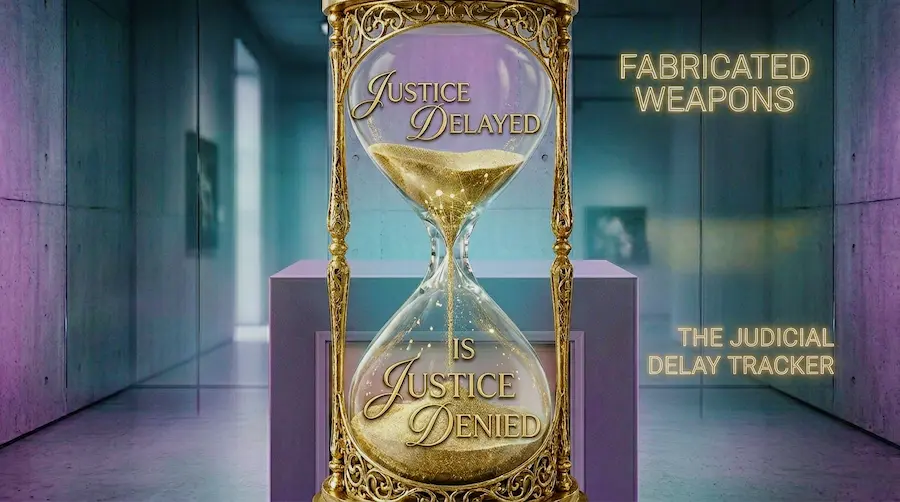
“Justice delayed is justice denied.” — Legal Maxim
In the architecture of justice, time is supposed to serve truth. It allows investigators to examine evidence, courts to assess competing accounts, and parties to prepare their cases. Yet time is not an impartial force merely because it appears on a calendar. Its effects are distributed unevenly. One party may experience delay as an administrative interval; another may experience the same interval as years of uncertainty, financial pressure, and suspended life.
A judicial process does not take place outside human existence. It consumes it. While a case remains unresolved, the people involved continue to age, work, pay bills, care for families, and live with the consequences of allegations that have not reached their final procedural destination. The court may eventually issue a judgment, but it cannot return the years spent waiting for it.
This is the central question of the chrono-politics of justice: who controls the time of a legal process, who bears its cost, and what happens when the duration of proceedings begins to shape the very conditions under which justice can be pursued?
Power is not exercised only through decisions. It can also operate through the postponement of decisions. A person waiting for an answer remains dependent on the institution that controls the timetable. The absence of a decision may leave the formal legal position unchanged, while the practical consequences of uncertainty continue to accumulate.
This does not mean that every delay is deliberate, unlawful, or intended to disadvantage a party. Complex proceedings require time, and institutions may face genuine constraints. But the legitimacy of a delay cannot be assessed solely by reference to administrative explanations. Its duration, causes, consequences, and proportionality must also be examined.
The critical distinction is between time used to clarify the truth and time that merely prolongs uncertainty. The former serves justice. The latter demands an explanation.
Case R 706/2025/5226 provides a concrete setting in which to examine these questions. The incident under consideration occurred on 29 December 2023. The District Court judgment was issued on 30 October 2025. The appeal was filed on 29 November 2025, and the hearing is scheduled for 6 October 2027.
These dates are more than administrative markers. They define the period during which the parties must continue to live with the consequences of the proceedings. They also raise questions about the relationship between the complexity of the issues, the time required to resolve them, and the practical burden imposed on those awaiting review.
The appeal process is intended to provide judicial scrutiny of the first-instance decision. But scrutiny has practical value only if it remains capable of addressing the issues in a meaningful way. When review is postponed for an extended period, the question of timeliness becomes inseparable from the question of effective access to justice.
The calendar does not determine whether a judgment is correct. Yet it can determine how long a person must wait for that correctness to be examined.
A delay is often described as though it were a neutral quantity: six months, one year, twenty-two months. But the same period can carry radically different meanings for the institution and for the individual. An institution may record a pending matter in a register. A person may experience it as an unresolved condition affecting finances, reputation, security, and the ability to plan the future.
This asymmetry deserves attention because procedural equality is not measured only by the formal rights available to each party. It also depends on whether those rights can be exercised under conditions that make them meaningful. A right that exists on paper but becomes increasingly costly to pursue raises a question about its practical effectiveness.
The deeper problem is not simply that justice takes time. It is that the burden of waiting may fall most heavily on the person least able to control the process.
A court can postpone a hearing without postponing the passage of a person’s life. The institution controls the schedule; the individual must live through it. That is why procedural time is never merely procedural.
The Finnish Criminal Code contains provisions concerning offences in public office, including abuse of public office and violation of official duty. Their application requires a careful examination of the statutory elements, the conduct in question, the relevant duties, and the available evidence. Delay alone does not establish a criminal offence.
Nevertheless, where procedural delays are accompanied by unanswered requests, unresolved record discrepancies, or decisions whose reasoning remains contested, a legitimate accountability question arises: have the relevant public duties been fulfilled in a manner consistent with the requirements of law and fair procedure?
The purpose of this audit is not to declare criminal liability in advance. It is to identify the documented conduct, establish the chronology, and examine whether the institutional response can be reconciled with the legal standards governing the administration of justice.
Audit Conclusion: When the Clock Becomes Part of the Case
The central concern is not that the judicial process has taken time in the abstract. It is whether the duration of the proceedings, considered alongside the documented evidentiary and procedural issues, has imposed a burden that is compatible with the right to a fair and effective examination of the case.
The questions are concrete:
- Were the periods of inactivity or delay adequately explained?
- Did the timetable preserve a meaningful opportunity to challenge the evidence and the reasoning of the judgment?
- Were discrepancies in the record addressed while clarification remained practically possible?
- Has the cumulative burden of the proceedings been considered from the perspective of the person required to endure them?
- Where public duties may have been inadequately performed, what mechanisms exist to examine that conduct independently?
These are not questions that can be answered by the calendar alone. They require records, reasons, and accountability.
Justice is not measured only by the decision eventually delivered. It must also be measured by the fairness of the path taken to reach it.
LawBeat Radio
Independent legal media platform focusing on structural judicial monitoring and criminal case analysis. We examine international standards of justice, from the presumption of innocence to the rigorous evaluation of the standard of proof and in dubio pro reo principles.
Legal Disclaimer:
All analytical materials and legal case reviews on this website are published for informational and educational purposes only under freedom of expression. Content does not constitute professional legal advice.
© 2026 LawBeatRadio. All rights reserved.