
ECHR Article 6: The Right to a Fair Trial
A structured guide to Article 6 of the European Convention on Human Rights, including fair hearing guarantees, presumption of innocence, and minimum rights of the defence.
Pélissier and Sassi v. France: Recharacterisation of Charges and the Right to Prepare a Defence
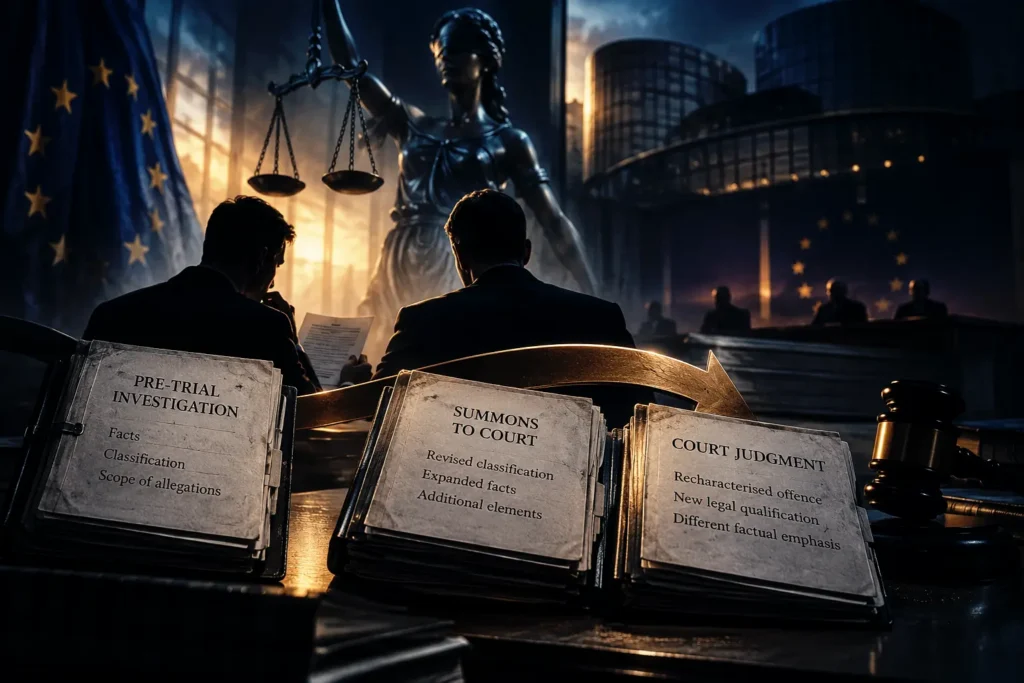
An analysis of Pélissier and Sassi v. France (25444/94), the Grand Chamber judgment on recharacterised criminal charges, notice of accusation, and the right to prepare an effective defence.
The Epistemic Function of Journalism

The Epistemic Function of Journalism: Why Verification Is Part of the Public Watchdog Role LawBeatRadio • Media Law & Investigative Journalism Journalism is often described as the right to inform the public. But before information can be responsibly published, someone has to determine whether it can be verified. That less visible function of journalism is increasingly important when reporting on courts, public authorities, and institutional decisions. A journalist does not merely transmit official statements. A journalist may also have to ask: What is the evidence? Where did it come from? Can it be independently checked? Does the documentary record correspond to the public account? And what happens when the material necessary to answer those questions is inaccessible? These questions point toward what may be called the epistemic function of journalism: journalism’s role in helping society establish, test, and communicate what can responsibly be known about matters of public concern. 1. Journalism Is Not Only About Publication The traditional description of press freedom tends to focus strictly on expression: information → publication → public debate But investigative journalism contains an essential earlier stage: information → investigation → verification → publication → public scrutiny The European Court of Human Rights has recognized that information gathering is an essential preparatory step in journalism and an inherent part of press freedom under Article 10 of the European Convention on Human Rights. That matters because verification is not simply a professional preference. It is part of the mechanism through which journalism can perform its democratic function. A journalist who publishes an allegation without checking its documentary basis is doing something fundamentally different from a journalist who obtains the underlying material, examines it, compares it with other records, and then reports what the evidence actually demonstrates. The difference is not merely stylistic. It is epistemic. 2. What Does “Epistemic” Mean in Journalism? The term epistemic concerns knowledge: how we know something, what justifies a belief, and what makes an assertion sufficiently reliable to be communicated as fact. Applied to journalism, the epistemic function can be understood through five basic operations: Finding: Locate information that is relevant to a matter of public concern. Obtaining: Gain access to documents, records, witnesses, photographs, recordings, or other primary material. Verifying: Test whether the information corresponds to the underlying evidence. Contextualizing: Place the verified information within its legal, institutional, and factual context. Communicating: Present the result to the public accurately, including relevant uncertainty and competing explanations. This creates an important principle: Responsible journalism does not begin with publication. It begins with verification. 3. The Journalist as a Verification Layer Modern democratic institutions produce enormous amounts of official information: Courts produce judgments. Police produce reports. Authorities produce decisions. Public institutions produce statistics, statements, and administrative records. But an official document is not necessarily the end of an inquiry. It can itself become an object of journalistic examination. This does not mean that journalists should presume official records to be false. The opposite principle is more useful: An official account should be treated as a source to be examined, not as a substitute for examination. That distinction is fundamental to investigative reporting. The journalist’s task is not to decide in advance that an institution is right or wrong. The task is to determine what the available evidence establishes. 4. Courts Present a Special Problem Reporting on courts creates an unusual epistemic situation. The public often receives the final institutional narrative through a judgment, press statement, or other official document. But the underlying evidentiary material may include: photographs; audio recordings; transcripts; exhibits; expert reports; procedural records; correspondence; physical evidence. The public account may therefore represent only the visible layer of a much larger evidentiary structure. This creates a fundamental journalistic question: Can a decision be meaningfully scrutinized if the material on which it depends cannot be independently examined? That is not an argument that confidential material must always be disclosed. Confidentiality can protect legitimate interests. The question is narrower: What degree of access is necessary for meaningful verification? 5. From “Freedom to Publish” to “Freedom to Investigate” This is where the traditional understanding of press freedom becomes particularly interesting. Article 10 protects freedom of expression, but the European Court’s case-law also recognizes the importance of information gathering. The Court describes the press as a public watchdog and has repeatedly emphasized the role of journalism in communicating information on matters of public interest. The Court has also recognized that this watchdog function is not necessarily limited to traditional newspapers. Its Article 10 guidance discusses journalists, NGOs, researchers, academics, bloggers, and other actors performing public-watchdog functions in appropriate circumstances. The concept therefore has a broader implication: The democratic value of journalism lies not merely in the existence of a publication. It lies in the process by which information becomes sufficiently reliable to enter public debate. 6. The Evidence Gap Consider a simple hypothetical structure: An institution makes a factual finding. A journalist wants to examine that finding. The relevant primary evidence exists. But the journalist cannot access it. The journalist therefore faces an evidence gap. There are now two possible forms of reporting: Reporting without verification “The institution says X happened.” This can be accurate as a report of what the institution says. But it does not establish that X actually happened. Reporting after verification “The institution says X happened. The underlying document was examined and shows Y.” This is fundamentally different journalism. The second form gives the public something more valuable than institutional repetition: an independently examined evidentiary account. 7. The Difference Between Access and Publication One of the most important distinctions in media law is between: access to information and the right to publish information. They are not the same question. A journalist may seek access to a document for the purpose of verification without necessarily intending to publish the document itself. For example, an investigator may need to examine an original photograph in order to determine whether a publicly described physical configuration is consistent with the photograph. The journalistic objective at
Judicial Bias and Errors
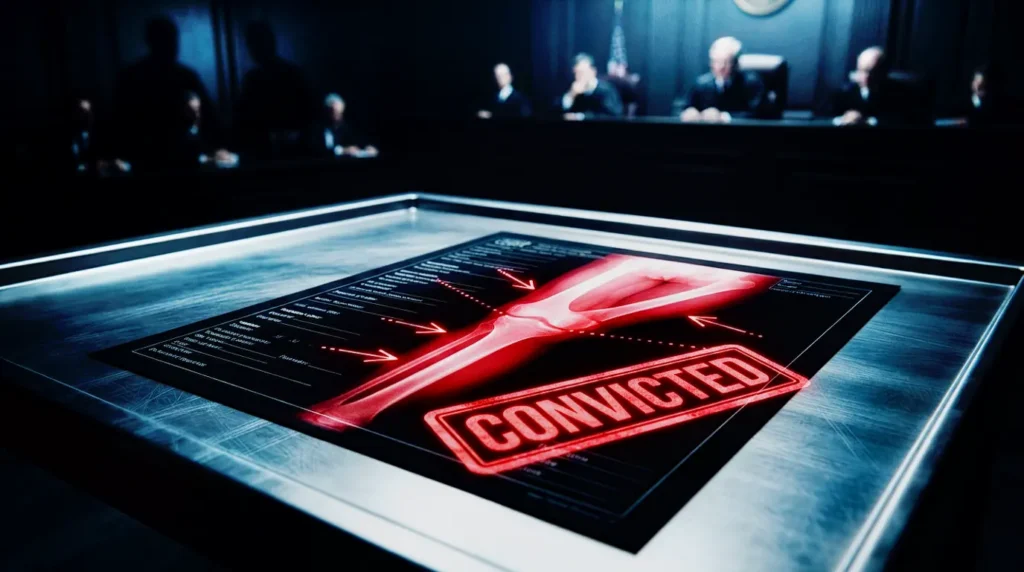
============================================================ LEGAL MEMORANDUM // INDEPENDENT CASE REVIEW ============================================================ TO: Case File & Analytical Archive FROM: Independent Legal Analyst DATE: August 23, 2026 RE: Judicial Bias and Errors ============================================================ I. Judicial Bias and Errors: Reversal of the Burden of Proof Issue: Did the judge violate the presumption of innocence by requiring the defence to disprove alternative scenarios or identify an alternative perpetrator? Rule: The prosecution bears the absolute burden of proof beyond a reasonable doubt, governed strictly by in dubio pro reo and the mandated standard of proof. The defence carries zero obligation to investigate, disprove, or discover alternative perpetrators. Application: Judge Inga-Liisa Paavola wrote explicitly in the verdict that the court “does not consider it probable” that anyone else threw the object, adding that “no such claim has been made.” This represents a catastrophic procedural error—improperly applying a civil standard of probability while illicitly shifting the burden of proof onto the accused. Conclusion: The judge unlawfully inverted the burden of proof, completely abandoning the criminal standard of proof and violating the core tenets of motive and intent analysis. In criminal adjudication, the logical and material alignment between the legal description of an offense and the supporting physical evidence is a mandatory prerequisite for a valid conviction. II. Textual Transmutation and Distortion of Witness Testimony Issue: Did the presiding judge commit procedural distortion by altering the substantive meaning of witness testimony during the free evaluation of evidence (vapaa todisteiden harkinta)? Can a court legally anchor a criminal conviction on invented facts entirely unsupported by oral depositions? Rule: Reliability of Evidence: Judicial findings must strictly reflect objective, unaltered facts presented during oral hearings. Limits of Evaluation: While procedural latitude allows courts to weigh evidence, it never grants the legal authority to fabricate or linguistically alter core testimonies to manufacture guilt. Fabricated Action: The written judgment invents the assertion that the accuser “entered the room angrily”—a detail completely absent from all pre-trial investigations and oral depositions. Application: During the oral trial, the accuser explicitly and unconditionally admitted that he “did not see” who threw the object, because his head was physically outside the doorway at the material time (resulting in zero visual visibility and total destruction of the reliability of evidence). To bridge this fatal evidentiary gap, Judge Paavola micro-injected the modifier “kunnolla” (properly/clearly) into the written verdict. Through this creative judicial editing, the absolute statement “he did not see” was transmuted into “he did not see clearly” (ei ollut kunnolla nähnyt), manufacturing a fictional “partial identification” out of thin air. Conclusion: The linguistic manipulation of witness testimony constitutes a direct falsification of the trial record, exposing institutional tunnel vision and invalidating any pretense of motive and intent or lawful standard of proof. Rule: Verdicts must rely strictly on evidence and testimonies entered into the record during proceedings. Application: The written judgment asserts that the accuser “entered the room angrily,” a detail completely absent from all pre-trial investigations and oral hearings. Conclusion: The judge fabricated narrative details out of whole cloth to engineer a false, cohesive story. III. Judicial Bias and Errors: Acceptance of Paranormal Physics and Speculative Timelines Issue: Did the presiding judge completely abandon rational judicial reasoning by adopting a scientifically and physically impossible timeline solely to manufacture premeditation and motive and intent? Rule: Physical Impossibility & Logic: Legal conclusions must strictly comply with objective physical reality. When a court’s foundational theory defies immutable natural laws or basic human logic, it must be decisively rejected under the criminal standard of proof and in dubio pro reo. Application: The Paranormal Ambush Theory: The court accepted a preposterous timeline transforming a spontaneous, unpredicted interaction into a calculated, hours-long premeditated ambush staged at 04:45 AM. The Logical Collapse: The accuser’s own sworn testimony confirmed that he arrived unexpectedly and returned to the area solely because his wireless headphone batteries happened to die at that exact moment. The Judicial Absurdity: For the court’s premeditation theory to hold valid, the defendant would have had to possess psychic foresight to monitor third-party battery levels in real time from behind a solid wall and closed door. Judge embraced this telepathic narrative while completely ignoring the total absence of motive and intent, prior contact, or rational expectation. Conclusion: By anchoring a criminal conviction to a physical and logical impossibility, Judge Paavola discarded rational free evaluation of evidence in favor of speculative, supernatural storytelling designed exclusively to protect a compromised prosecution and suppress alternative perpetrators. The integrity of judicial fact-finding depends on the precise correspondence between the written charge and the verified evidence. IV. Judicial Bias and Errors: Anatomical Contradiction and Sealed Evidence Issue: Can a court legally validate a criminal conviction when the written verdict explicitly cites an impact to one anatomical zone (thigh / reiteen), while the underlying supporting physical evidence documents an entirely different body part (shin / säären)? Rule: Standard of Proof & Reliability of Evidence: A criminal conviction requires absolute proof beyond a reasonable doubt, governed strictly by in dubio pro reo. The physical evidence must directly and logically support the specific charges and judicial findings without internal contradictions, anatomical mismatches, or institutional concealment such as a 100-year case sealing order. Application: The Written Charge: The official court judgment explicitly records that the alleged kinetic impact was directed specifically at the upper leg / thigh (reiteen). The Evidentiary Mismatch: The underlying photographic exhibit—further obscured or protected by administrative secrecy and a 100-year classification protocol—references an anonymous injury located entirely on the lower leg / shin of an adult male. The Logical Gap: Using a photograph of a shin to substantiate a judicial finding of a thigh impact creates an unbridgeable physical contradiction, completely destroying the reliability of evidence and the criminal standard of proof. Conclusion: An evidentiary record that contradicts its own anatomical targets fails the absolute threshold of factual truth. Combined with administrative secrecy, this fatal mismatch renders the conviction entirely legally void under the principles of objective justice and in dubio pro reo. In Case R 706/2025/5226, a forensic review
Cat Tree vs. Flying Chair: A Physics Review
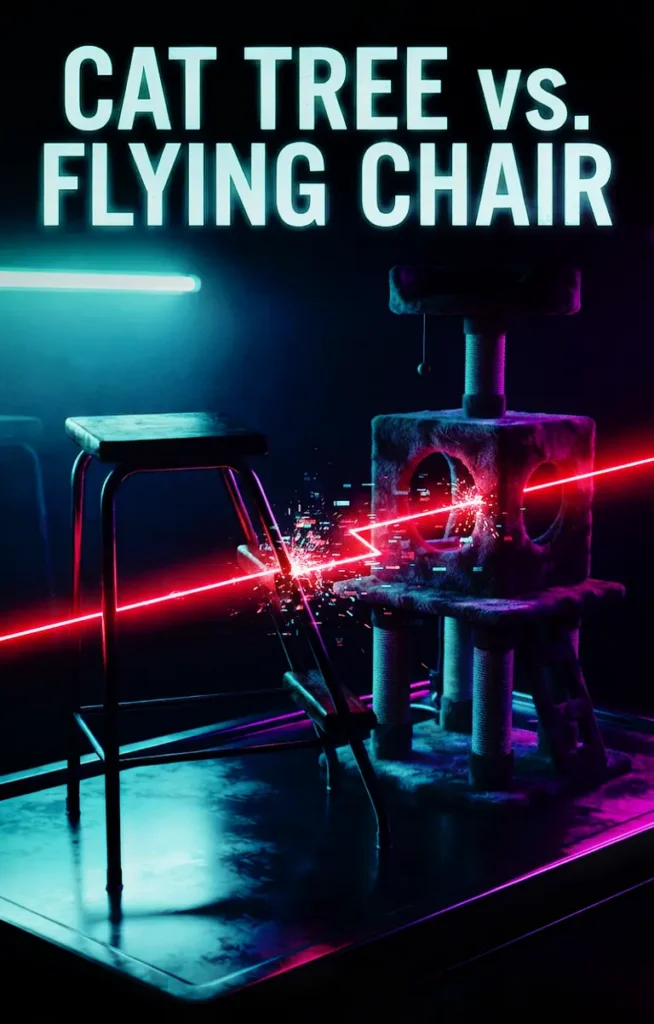
================================================== LEGAL MEMORANDUM // INDEPENDENT CASE REVIEW ================================================== TO: Case File & Analytical Archive FROM: Independent Legal Analyst DATE: August 23, 2026 RE: Cat Tree vs. Flying Chair: A Physics Review ================================================== 1. Issue In this analytical review Cat Tree vs. Flying Chair, does a judicial verdict retain legal reliability and satisfy the criminal standard of proof when the physical mechanism of the alleged injury directly contradicts the laws of trajectory, objective scene geometry, and anatomical location, thereby violating the presumption of innocence and in dubio pro reo? 2. Rule Standard of Proof: Criminal conviction requires proof beyond a reasonable doubt, where every material fact must maintain absolute logical and physical consistency. Reliability of Evidence: Judicial findings must rely on authentic, verifiable forensic data rather than uncorroborated, contradictory testimonies or contextless photographs. Physical Impossibility & Alternative Perpetrator: If the alleged kinetic action is spatially and physically impossible, or if material evidence points to structural contradictions, the narrative collapses, triggering in dubio pro reo in favor of the defense. Motive and Intent: Fabricated physical mechanisms inherently destroy the logical foundation of motive and intent, exposing institutional bias and confirmation bias. Cat Tree vs. Flying Chair. A ruthless IRAC review tearing apart a fabricated judicial narrative. 3. Application & Technical Deconstruction A. Cat Tree vs. Flying Chair: Physical & Technical Impossibility of the Allegation Technical Analysis of the Incident Scene: The entire conviction relies on the accuser’s shifting testimony, which directly violates the laws of trajectory, spatial dimensions, and the objective reality documented in police evidence logs. The “Door Barrier” Geometry: The accuser claimed the door was obstructed by furniture and opened only at a narrow angle, while a large, metal-framed kitchen step-ladder was allegedly thrown from an elevated position to strike his shin. The Physical Impossibility: Scene photographs confirm the partially open door acts as a rigid barrier. A bulky, angular object like a heavy step-ladder cannot be thrown through a narrow, acute-angled gap without colliding violently with the door frame or the door itself. Trajectory analysis confirms the angle required to strike a lower limb in this confined space is a physical impossibility. Obstruction by Permanent Fixtures: Crime scene photos show permanent floor-to-ceiling structures (cat climbing towers) positioned directly across the required “throwing lane.” These installations occupy the entire airspace above and adjacent to the entry point, leaving zero clearance for a launch. Suppressed Evidence: Although these fixed obstacles appear plainly in police case photos, the court completely ignored them. This deliberate blindness protects a fabricated narrative that defies basic physics and destroys the reliability of evidence. Cat Tree vs. Flying Chair. A ruthless IRAC review tearing apart a fabricated judicial narrative. B. Invalidity of Photographic Evidence & Lack of Medical Verification Forensic Audit of Photographic Exhibits: The prosecution introduced a low-grade photograph of a shin bruise as alleged “proof” of the assault. This exhibit fails every basic legal and forensic threshold, directly sabotaging the required reliability of evidence. Lack of Identification and Authenticity: The photograph is unverified, low-resolution, and devoid of professional metadata. It exhibits severe anatomical ambiguity (impossible to identify left vs. right limb or specific body zone) and lacks timestamps, chain-of-custody logs, or proof of ownership by the accuser. The “Anonymous Bruise” Problem: In any legitimate court, a contextless snapshot unsupported by an official forensic medical examiner’s report has zero probative value. Absence of Causality: Because the alleged physical mechanism (throwing a metal step-ladder through a narrow, obstructed doorway) is a proven physical impossibility, the purported injury cannot possess a causal link to the defendant. This complete collapse of logic invalidates both motive and intent. Discrepancy Between Injury and Mechanism: The minor mark shown fails to match the severe, distinct structural trauma or lacerations expected from a heavy, angular metal-framed ladder striking a limb, directly contradicting the accuser’s narrative. Judicial Confirmation Bias: The trial court’s uncritical reliance on an unverified, anonymous photo violates the presumption of innocence, in dubio pro reo, and the strict standard of proof, willfully ignoring alternative explanations and basic physics. Furthermore, the systemic failure to authenticate visual exhibits establishes a dangerous precedent of unverified judicial acceptance. When digital or physical representations of injuries are admitted into the official record without a chain of custody, time stamps, or professional medical attestation, the integrity of the judicial process is entirely compromised. A court cannot lawfully substitute forensic certainty with generalized visual assumptions without reducing the standard of proof to an arbitrary exercise of subjective discretion. C. Anatomical Contradiction: Does a Criminal Court Need to Know Which Body Part Was Hit? A rigorous audit of Case R 706/2025/5226, presided over by Judge Inga-Liisa Paavola, exposes a profound, fatal disconnect where the official written judgment completely diverges from the underlying evidentiary record: What the Judge Wrote: The official text of the court’s judgment explicitly records that a kinetic impact was directed specifically at the thigh (reiteen). What the Evidence Actually Shows: The sparse evidentiary dossier includes visual materials concerning a 37-year-old male, yet the prosecution’s own exhibits and testimony connect these records to an alleged injury located entirely on the shin (säären). The Core Legal Failure: Substituting a photograph of a shin to substantiate a judicial finding of a thigh impact shatters the absolute reliability of evidence. It directly violates the criminal standard of proof, ignores in dubio pro reo, erases the logical foundation of motive and intent, and disregards the possibility of an alternative perpetrator or self-inflicted damage. This fatal anatomical contradiction exposes the utter collapse of judicial due diligence. The prosecution’s written verdict formally convicts based on an alleged impact to the thigh (*reiteen*), yet the sole evidentiary exhibit—a rudimentary, unauthenticated WhatsApp snapshot—depicts an entirely different anatomical zone: the shin (*säären*). To sentence a defendant for a kinetic action on one part of the body while resting the entire proof of guilt on an anonymous bruise located somewhere else is not a legal error; it is an absolute systemic failure. When a court cannot even correctly identify or match the body part allegedly
The Wall-Eyed Witness
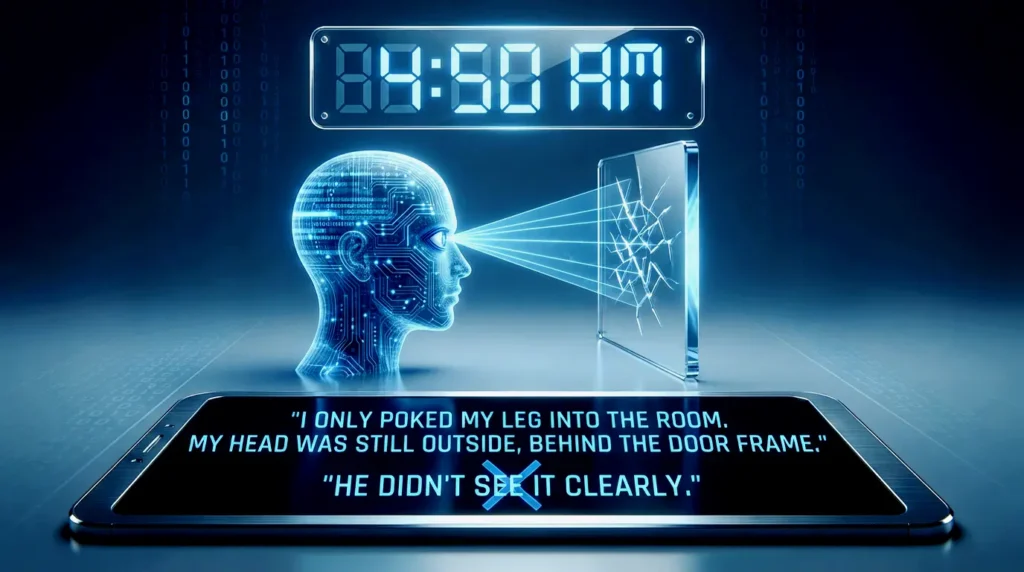
Forensic Audit • The Wall-Eyed Witness The Wall-Eyed Witness If the witness did not see the alleged throw, what exactly did he observe — and what did he infer? The Critical Sequence The trial testimony describes a specific sequence of events. N stated that the heavy ten-kilogram oak-and-metal stepladder came from above and struck his leg. He then raised his head and saw TG standing on the upper landing with a broom in her hand. But when counsel asked the direct question — whether he had actually seen her throw the heavy ten-kilogram oak-and-metal stepladder — N answered: “I did not see it.” That distinction matters. The testimony separates what N observed from what he later inferred. What He Saw — And What He Did Not According to his own account, N had only inserted his leg into the narrow entrance area when the ladder struck it. His head remained outside the doorway. He then raised his head. At that point, he said, he saw TG standing above him with a broom in her hand. “I only put my leg into the room. My head was still outside, behind the door frame. If my head had been inside, the object would have hit my head.” This creates a precise evidentiary question. If N’s head was still outside the doorway when the impact occurred, and he expressly stated that he did not see the throw, then his later identification of the alleged thrower was not based on direct observation of the act itself. Observation or Inference? After answering that he did not see the throw, N explained why he nevertheless considered TG to be the person who had thrown the ladder: in his view, it would be logical to assume that she had done so because he saw her standing above him immediately afterward. That is an inference from the surrounding circumstances. It is not the same thing as seeing the act itself. Forensic Distinction Observation: the heavy ten-kilogram oak-and-metal stepladder struck his leg; he raised his head and saw TG above him with a broom. Inference: it was therefore logical to assume that TG had thrown the heavy ten-kilogram oak-and-metal stepladder. The Physical Setting The account also has to be tested against the physical environment described in the record. N described a narrow entrance, with chairs placed behind the door. The police photograph shows additional structures above and around the doorway, including the large cat-tree structure directly over the upper area. The alleged object was not described as a small or easily handled item. N described the kitchen ladder as heavy, approximately 10 kilograms, and made of solid oak. The question is therefore not whether a particular physical sequence should simply be declared “impossible.” The question is whether the evidence establishes how that sequence could have occurred in the confined and obstructed space shown in the record — including the transition from the alleged throw to the moment when TG was already standing above him with the broom in her hand. LawBeatRadio Forensic Audit The critical issue is not whether N’s inference was conceivable. It is whether the written judgment preserved the distinction between what he actually saw and what he inferred. He expressly stated that he did not see the heavy ten-kilogram oak-and-metal stepladder being thrown. His own account places his head outside the doorway at the moment of impact. Only afterward did he raise his head and see TG standing above him with a broom. That distinction is not a matter of style. It goes directly to the evidentiary meaning of the testimony. The Logical Problem: What Could He Actually See? The issue begins with N’s own description of his position at the moment of impact. He stated that he had inserted his leg into the narrow entrance area while his head remained outside, behind the door frame. He then said that the ladder struck his leg. He did not describe seeing the ladder being thrown. When counsel asked him directly whether he had seen the throw, he answered: “I did not see it.” Only after the impact, according to his account, did he raise his head. At that point he said he saw TG standing above him with the broom in her hand. The Critical Distinction This creates a precise distinction between observation and inference. What N said he observed The ladder struck his leg. He raised his head. He then saw TG standing above him with a broom in her hand. What N inferred Because TG was standing above him after the impact, he considered it logical to assume that she had thrown the heavy ten-kilogram oak-and-metal stepladder. Those are not the same evidentiary proposition. The first concerns what the witness says he directly perceived. The second is his conclusion drawn from the circumstances. The Geometry of the Moment N also explained why he believed his position mattered. He said that if he had entered the apartment head-first, the heavy ten-kilogram oak-and-metal stepladder would have struck his head. In his account, therefore, his head had not yet crossed into the relevant area when the heavy ten-kilogram oak-and-metal stepladder struck his leg. “If I had entered the apartment head-first, the heavy ten-kilogram oak-and-metal stepladder would certainly have hit my head.” This matters because the position of the head determines the position of the eyes and therefore the available line of sight. The testimony itself places the witness’s head outside the doorway at the moment of impact — followed only afterward by his raising his head and seeing TG above him. The Wording Question The significance of this distinction becomes critical when the trial testimony is compared with the wording used in the written judgment. The testimony contains an explicit answer: he did not see the throw. If the judgment instead characterizes the testimony as meaning that he merely did not see the event clearly, the difference is substantial. “Did not see” describes the absence of
Physical Impossibility as a Basis for Wrongful Conviction in Finland
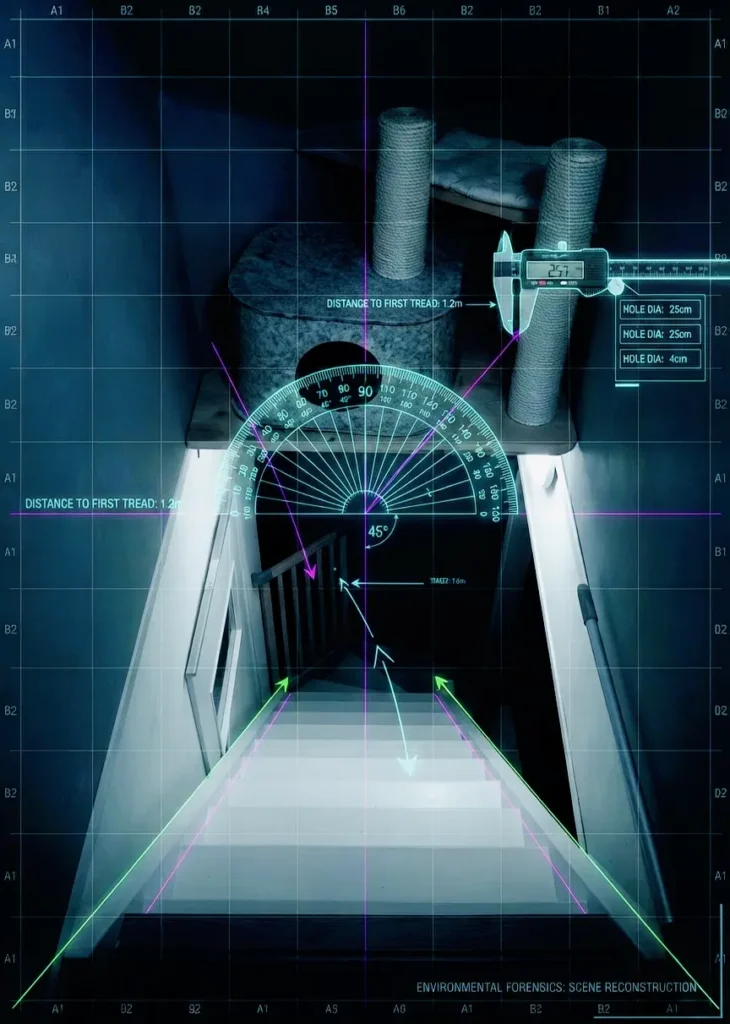
LawBeat Radio Analysis Physical Impossibility as a Basis for Wrongful Conviction in Finland Abstract In the assessment of criminal liability, testimonial evidence must cohere with the immutable laws of physics and spatial geometry. When a judicial decision relies on a narrative that is demonstrably contradicted by objective crime scene data, the foundational standard of proof beyond a reasonable doubt is compromised. This analysis examines a documented case of judicial error wherein structural barriers, fixed architectural fixtures, and geometric constraints rendered the accuser’s allegations physically impossible, exposing systemic flaws in evidentiary evaluation. 1. Introduction: The Supremacy of Physical Reality over Testimonial Claims The integrity of a criminal proceeding depends on the objective verification of facts. In Judgment No. 1037 6624, the conviction rests exclusively on the subjective narrative provided by the accuser, without adequate reconciliation of material discrepancies at the scene. For students of jurisprudence and forensic science, this case serves as a critical study in epistemic failure: the uncritical acceptance of witness testimony that violates spatial mechanics and basic physical laws. 2. Spatial and Geometric Analysis A. The “Door Barrier” Geometry The primary allegation involved the purported hurling of a bulky, metal-framed kitchen step-ladder through a compromised entry point. Photographic documentation (Exhibit 4) establishes that the room’s access point was restricted by a chair and maintained a narrow, fixed angle. A rigid, angular object cannot traverse a narrow aperture without structural collision; the trajectory is a physical impossibility. B. Obstruction by Permanent Architectural Fixtures The surrounding spatial matrix contained permanent floor-to-ceiling structures that occupied the volumetric space necessary for a throwing motion. Despite being documented within official police photographic records, these permanent structures were omitted from the court’s physical assessment, illustrating a critical failure to weigh exculpatory material evidence. 3. Jurisprudential Implications Standard of Proof: When physical evidence demonstrates that an event could not have occurred as described, reasonable doubt is established as a matter of law. Objective vs. Subjective Evidence: Subordinating objective reality (photographs, measurements) to unverified, malleable testimony invalidates the logical integrity of the judicial process. Principle of In Dubio Pro Reo: Unreconciled physical contradictions must be resolved in favor of the defense. Disregarding physical laws to preserve a preferred narrative forces the accused to disprove an abstract impossibility. 4. ConclusionJudgment No. 1037 6624 illustrates the dangers of divorcing judicial fact-finding from forensic reality. When a court constructs a legal conclusion upon a foundation of physical impossibilities, the decision ceases to be an act of justice and becomes an administrative fiction. LawBeat Radio | Podcast Episode: The Persistent Illusion of Justice Listen to the complete audio investigation as we draw the historical line from the 1819 Boorn brothers show trial straight into the modern evidentiary vacuum of The Victim-Criminal Flip Case R706/2025/5226, Finland. Discover how physical impossibilities, 100-year state secrecy stamps, and institutional cover-ups undermine the very core of judicial integrity. LAWBEAT RADIO // AUDIO BROADCAST Episode: The Persistent Illusion of Justice & The 21st Century Parallel Your browser does not support the audio element.
Judgment Audit № 1037 6624: A Forensic Review of Judicial Evidence

LawBeat Radio Forensic Audit Judgment Audit: Deconstructing Judicial Malpractice “When a court prioritizes a fabricated narrative over physical reality and forensic facts, it ceases to function as a court of law and becomes an instrument of institutional malpractice.” Judgment № 1037 6624 stands as a textbook demonstration of systemic procedural collapse. A rigorous forensic audit of the case reveals a total abandonment of the foundational pillars of Western jurisprudence: the Presumption of Innocence, In Dubio Pro Reo, the absolute requirement for the Reliability of Evidence, and strict adherence to the Standard of Proof. By constructing a narrative that defies the laws of physics, ignoring documented physical impossibilities, weaponizing secret mobile interrogations, and imposing an absurd 676-day appellate limbo, the Finnish judicial machinery transformed a retaliatory fabrication (vastasyytös) into an unjust conviction. I. Procedural Violations & Human Rights 1. The Secret Mobile Interrogation (April 24, 2024) The Breach: Investigative authorities committed a fundamental violation of the Pre-trial Investigation Act and Article 6 of the ECHR by secretly altering the individual’s procedural status from “Victim” (Asianomistaja) to “Suspect” (Vastaaja) during an active mobile phone transit. The Coercion: Conducted under extreme ambient noise at a train station with a degraded mobile connection, the investigator deliberately bypassed mandatory legal safeguards. The Consequence: The individual was stripped of the right to counsel, denied a Miranda warning, and forced into self-incrimination under the false pretense of still holding victim status. Evidence acquired via this procedural ambush is legally inadmissible. 2. The 676-Day Appellate Limbo (Institutional Betrayal) The Timeline: Following the District Court decision on October 30, 2025, and the timely appeal filed on November 29, 2025, the appellate review was pushed to October 6, 2027—a staggering 676-day delay. The Impact: This protracted delay directly violates Section 21 of the Finnish Constitution and Art. 6 ECHR regarding the right to a speedy trial. Forcing an appellant to carry an unmerited criminal stigma for nearly two years constitutes an administrative form of psychological torture and secondary institutional assault. II. Physical & Technical Impossibilities 1. The “Door Barrier” Geometry (Exhibit 4) The Allegation: The accuser claimed a heavy, metal-framed kitchen step-ladder was thrown through a doorway obstructed by a chair, striking his shin.The Physical Reality: Crime scene photographs in Exhibit 4 confirm that the partially open door and permanent floor-to-ceiling structures (cat climbing towers) created an absolute geometric barrier. A bulky, angular object cannot be hurled through a narrow, blocked gap without colliding with the door frame or fixed structures. The trajectory is a physical impossibility. 2. The Logistical Absurdity of the “Ambush” The Unpredictable Arrival: The accuser arrived unannounced at 4:50 AM solely because his headphone battery died.The “Psychic” Requirement: For the court’s ambush theory to hold, the defendant must have possessed psychic foresight—standing in total darkness waiting for a random power failure to trigger an arrival. The absence of Motive and Intent completely invalidates this hypothesis. 3. The 30-Second Timeline Collapse The accuser’s narrative forces clearing furniture, ascending stairs, enduring a falling ladder, and sustaining multiple assaults into an impossible 30-second window across an unreachable 4-meter distance. Time, space, and physics entirely refute the claim. III. Judicial Errors & Evidence Suppression Fabrication of Facts: The court invented an “angry entry” into the room—a detail completely absent from all testimonies—to manufacture a cohesive false narrative. Linguistic Manipulation: The presiding judge deliberately replaced the accuser’s admission of “did not see” with “did not exactly see” to fabricate the illusion of a partial identification. Suppression of Evidence: Official police photographs documenting structural barriers and the accuser’s own weapon possession were completely disregarded. Invalid Medical Evidence: An anonymous, contextless photograph of a bruise lacking medical verification, timestamps, or anatomical identification was accepted as proof, ignoring the absence of a causal link. IV. Failure of Evidentiary Standards Legal Pillar Judicial Failure in № 1037 6624 Standard of Proof Conviction secured entirely on shifting hearsay rather than meeting the “Beyond a Reasonable Doubt” threshold. In Dubio Pro Reo All contradictions, physics-defying timelines, and logical gaps were resolved against the defendant. Burden of Proof Unlawfully shifted (Probatio Diabolica) by forcing the defendant to disprove a fabricated narrative while ignoring the accuser’s own admission of weapon possession. Alternative Perpetrator Ignored the clear framework of a retaliatory accusation (vastasyytös) designed to deflect from the accuser’s unprovoked physical aggression and death threats (“Die! Die! Die!”). V. Conclusion & Forensic Verdict Judgment № 1037 6624 represents a complete systemic failure. By elevating a shifting, physically impossible lie over forensic reality, the judiciary abandoned its duty of objective arbitration. The Evidence: Contradicted by physics (Exhibit 4). The Procedure: Compromised by secret mobile interrogations and a 676-day delay. The Law: Violated at every level of the evidentiary standard. This archive stands as documented proof of institutional malpractice that demands total appellate reversal. Surgical Application Note:When judicial review relies on geometric impossibilities and covert procedural ambushes, the core tenets of in dubio pro reo and the presumption of innocence are entirely subverted. Reversing Judgment № 1037 6624 is not merely an appellate correction—it is an absolute prerequisite for restoring institutional integrity. Judgment Audit № 1037 6624, Finland LawBeat Radio | Podcast Episode: The Persistent Illusion of Justice Listen to the complete audio investigation as we draw the historical line from the 1819 Boorn brothers show trial straight into the modern evidentiary vacuum of The Victim-Criminal Flip Case R706/2025/5226, Finland. Discover how physical impossibilities, 100-year state secrecy stamps, and institutional cover-ups undermine the very core of judicial integrity. LAWBEAT RADIO // AUDIO BROADCASTEpisode: The Persistent Illusion of Justice & The 21st Century Parallel Your browser does not support the audio element.
The Feline Alibi: A Forensic Review of the Documented Scene
Case Analysis The Feline Alibi: Exposing Physical Impossibility When an investigation mutates behind closed doors, the legal strategy built during the pre-trial phase instantly becomes a liability. Because the defence prepares to fight the original accusations, a sudden pivot in the courtroom leaves critical evidence completely unexamined through the lens of the new, fabricated narrative. This creates a lethal blind spot—one where the prosecution’s own case file contains definitive proof of physical impossibility, yet the defence walks right past it, lulled into a false sense of security by the assumption that the court will naturally recognize the absurdity. 1. The Evidentiary Record: Three Photographs and the Missing Analysis In a system where the evidentiary record is limited, the evidentiary foundation is often remarkably thin. When the police file contains zero forensic analysis, independent expert evaluations, or material evidence – relying instead solely on a meager collection of three photographs taken at the scene – every single pixel becomes a battleground. One specific police photograph, captured minutes after the alleged incident, tells a damning story that completely dismantles the state’s new new account, challenging any purported reliability of evidence. 2. The Physical Question: The Alleged 10 kg Yakkara Trajectory The prosecution’s updated narrative hinges on the claim that a heavy 10 kg yakkara (or object) was forcefully dropped or thrown from a specific elevated point. However, looking closely at the police crime scene photo reveals an documented physical obstruction: The Structural Obstruction: Directly above the alleged launch point, a solid, permanent structure of custom cat scratch posts is firmly erected. This heavy, multi-tiered build physically blocks any trajectory from that location. The Door Swing Limit: The precise geometry of the room, including the angle of an immovable open door, creates a physical barrier that makes sliding, positioning, or tossing a 10 kg object through that space entirely impossible. The Untouched Reality: Captured mere minutes after the event by law enforcement themselves, the photograph shows these structures completely undisturbed, proving that the state’s kinetic scenario is a physical fantasy, totally detached from any logical motive and intent or realistic alternative perpetrator assessment. 3. Why the Documented Obstruction Requires Examination Why was this glaring physical contradiction missed by the defenсe? The answer lies in the psychological trap of procedure: The Change in Evidentiary Theory: Because this specific mechanism of the crime was never introduced during the pre-trial phase, the defenсe was focused on dismantling the original accusations. When the narrative changed at trial, the defenсe assumed the sheer incoherence of the shift would be self-evident to any rational observer. The Court’s Assessment of the Physical Evidence: The defenсe trusted that the presiding judge—who had an entire month to review the case file, examine the meager three photographs, and verify the physical reality of the scene—would independently spot the impossibility. This reliance exposes the core vulnerability: reliance on the court to identify the evidentiary issue. When a court is motivated to secure a conviction rather than uncover the truth, a judge will ignore clear photographic proof of physical impossibility, leaving an innocent person trapped by their own naive expectation that the system will correct its own lies, trampling the constitutional presumption of innocence. Forensic Questions Raised by the Documented Scene When the prosecution introduces a narrative that requires a physical explanation, and the defence is blindsided by a mid-trial shift in accusations, passive observation is a death sentence. To dismantle a case grounded in a physical impossibility and protected by a compromised judiciary, you must deploy aggressive, structural countermeasures: Audit the Photographic Record: Instantly motion for a formal, frame-by-frame technical examination of the police crime scene photographs. Force the prosecution to reconcile their narrative with the physical realities captured in their own documentation—such as the permanent structures of the cat scratch posts and the blocking angle of the door. Test the Alleged Trajectory: Invoke the universal legal principle that physical impossibility destroys the actus reus entirely. If the objective laws of physics, spatial geometry, and structural blockades make it impossible to move a 10 kg yakkara through a given trajectory, no amount of witness testimony or judicial bias can override reality. Expose the Prosecution’s Evidentiary Void: Highlight the absence of independent forensics. Remind the record that when an entire criminal accusation rests on a meager three police photographs with zero material analysis, any structural contradiction within those photos acts as a wrecking ball to the entire state’s case. Examine the Court’s Treatment of the Evidence: Explicitly challenge the court’s month-long failure to evaluate its own evidence. Under standard legal obligations, a judge reviewing a case file is bound to spot blatant physical discrepancies; when a court deliberately ignores physical impossibilities, it proves the existence of bad faith and administrative collusion. Apply the Relevant Evidentiary Standards: Force the application of in dubio pro reo by demonstrating that the narrative shift and the documented physical obstructions leave an unbridgeable chasm in the standard of proof. A case riddled with spatial impossibilities fails to meet the threshold of reliable evidence, demanding an immediate dismissal of charges. Forensic Conclusion:When judges ignore indisputable photographic proof of structural blockades and physical impossibilities to preserve a shifted state narrative, they commit a severe abuse of public office, reducing the trial to a fraudulent exercise in manufactured guilt. The Feline Alibi
The Courtroom Ambush: When Fantasy Replaces Facts and You Expect Ultimate Justice
The Courtroom Ambush : Fantasy vs. Facts When a fabricated case finally reaches the courtroom, the shock is rarely just about the charges—it is about the complete detachment from reality. If you survived the pre-trial phase of hidden status changes and ambush phone calls, the trial itself often unveils a brand-new, customized narrative tailored on the fly. 1. The Morphing Accusation: From Chaos to Comic Book Physics In a lawful judicial process, the charges brought to trial must strictly mirror the pre-trial investigation. In a corrupted system, the script gets rewritten right in front of you: The Pre-Trial Version: You woke up to the noise of chairs being shoved near your door by the accuser, reacted instinctively, and defended your space. The Courtroom Evolution (The “10-KG Chair Ambush”): Suddenly, inside the courtroom, reality is replaced by a cinematic farce. You are now cast as an ambush predator waiting for the accuser’s headphone battery to die, plotting the exact second to drop a 10-kilogram chair on them the moment they cross the threshold—while somehow simultaneously thrusting a brush across an impossible 4-meter distance, directly violating the laws of physical impossibility. The Erasure of Chronology: When, how, and why these physics-defying events supposedly occurred stops mattering. Timestamps disappear because the “facts” are manufactured to fit a pre-determined verdict, rendering any genuine assessment of motive and intent or an alternative perpetrator entirely irrelevant. 2. The Trap of Naivety: Believing the Court Cares About Truth The most dangerous weapon the system uses against an innocent person is not just the forged evidence—it is your own psychological compliance. The “Rule of Law” Illusion: Sitting in the courtroom, watching the absurdities unfold, the natural initial reaction of an innocent person is compliance and quiet trust: “Surely, this is a fair court. The Rule of Law applies here. Why interfere or panic? The judge will obviously see the truth.” The Fatal Miscalculation: Assuming the court is an objective seeker of truth. In a rigged proceeding, the court is often an administrative conveyor belt designed to rubber-stamp the prosecution’s fantasy while ignoring the fundamental presumption of innocence. Silence is interpreted not as dignity, but as submission; passivity hands them total victory. 3. Your Self-Defense Countermeasures Shatter the Illusion Immediately: Realize instantly that the court does not automatically seek truth; it evaluates the procedural boundaries you defend. Passive waiting is tactical suicide. Expose the Narrative Shift: Legally challenge the glaring contradictions between the pre-trial records and the novelistic fairy tales presented in court. Under the principles of reliability of evidence and motive and intent, a changing story is a false story. Demand Strict Standards of Proof: Force the prosecution to anchor their claims in physical reality rather than absurd hypotheses. If the core accusations rely on logical impossibilities (physical impossibility), the case must collapse under in dubio pro reo. Expose the Alternative Perpetrator and Motive Gaps: Force the court to examine alternative explanations and structural holes in the prosecution’s timeline. If the sequence of events defies logic, highlight who else or what other motivations could realistically explain the scenario, stripping away the fabricated narrative. Tear Down the Presumption of Innocence Manipulation: Attack how the system subtly shifts the burden of proof onto you, forcing the defense to disprove a fantasy rather than making the state prove its case. Remind the bench that under the true Presumption of Innocence, an unproven, shape-shifting accusation is legally weightless, and every structural doubt must unconditionally favor the accused. Audit Conclusion:When courtrooms operate as administrative conveyor belts for fabricated comic-book narratives, they commit a severe abuse of public office and entirely subvert the required criminal standard of proof. The Courtroom Ambush