
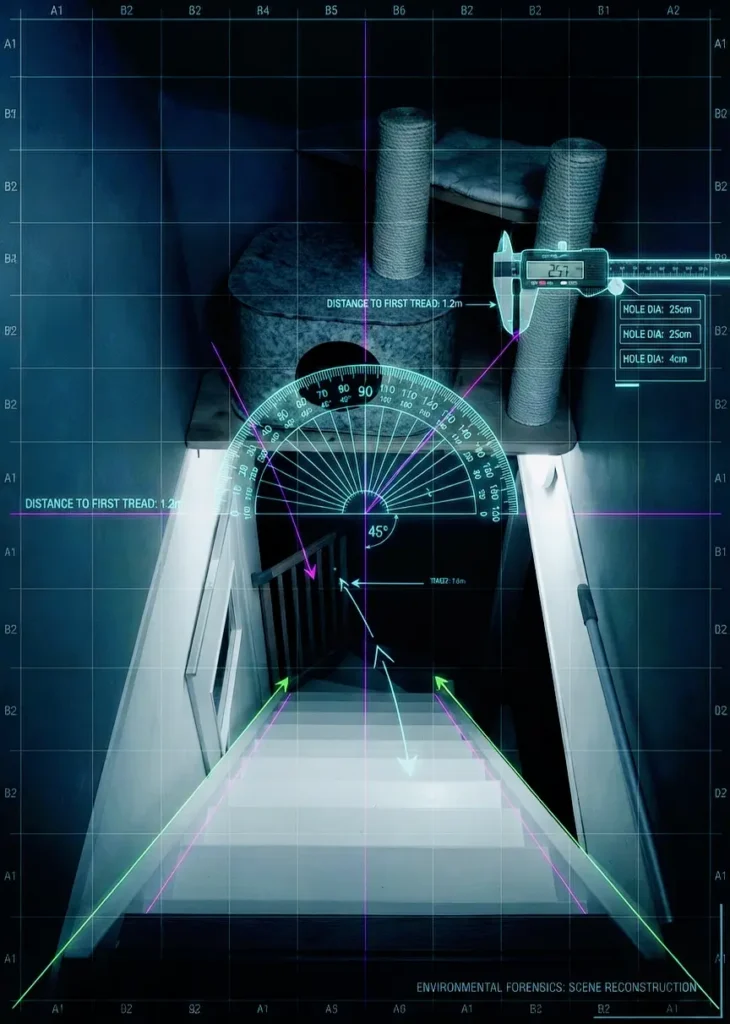
In the assessment of criminal liability, testimonial evidence must cohere with the immutable laws of physics and spatial geometry. When a judicial decision relies on a narrative that is demonstrably contradicted by objective crime scene data, the foundational standard of proof beyond a reasonable doubt is compromised. This analysis examines a documented case of judicial error wherein structural barriers, fixed architectural fixtures, and geometric constraints rendered the accuser’s allegations physically impossible, exposing systemic flaws in evidentiary evaluation.
The integrity of a criminal proceeding depends on the objective verification of facts. In Judgment No. 1037 6624, the conviction rests exclusively on the subjective narrative provided by the accuser, without adequate reconciliation of material discrepancies at the scene. For students of jurisprudence and forensic science, this case serves as a critical study in epistemic failure: the uncritical acceptance of witness testimony that violates spatial mechanics and basic physical laws.
The primary allegation involved the purported hurling of a bulky, metal-framed kitchen step-ladder through a compromised entry point. Photographic documentation (Exhibit 4) establishes that the room’s access point was restricted by a chair and maintained a narrow, fixed angle. A rigid, angular object cannot traverse a narrow aperture without structural collision; the trajectory is a physical impossibility.
The surrounding spatial matrix contained permanent floor-to-ceiling structures that occupied the volumetric space necessary for a throwing motion. Despite being documented within official police photographic records, these permanent structures were omitted from the court’s physical assessment, illustrating a critical failure to weigh exculpatory material evidence.
4. Conclusion
Judgment No. 1037 6624 illustrates the dangers of divorcing judicial fact-finding from forensic reality. When a court constructs a legal conclusion upon a foundation of physical impossibilities, the decision ceases to be an act of justice and becomes an administrative fiction.
Listen to the complete audio investigation as we draw the historical line from the 1819 Boorn brothers show trial straight into the modern evidentiary vacuum of The Victim-Criminal Flip Case R706/2025/5226, Finland. Discover how physical impossibilities, 100-year state secrecy stamps, and institutional cover-ups undermine the very core of judicial integrity.
LawBeat Radio
Independent legal media platform focusing on structural judicial monitoring and criminal case analysis. We examine international standards of justice, from the presumption of innocence to the rigorous evaluation of the standard of proof and in dubio pro reo principles.
Legal Disclaimer:
All analytical materials and legal case reviews on this website are published for informational and educational purposes only under freedom of expression. Content does not constitute professional legal advice.
© 2026 LawBeatRadio. All rights reserved.