
Independent Forensic Audit
The circumstances documented in Case R 706/2025/5226 raise questions under the following provisions of Finnish criminal and procedural law:
These provisions do not all establish criminal liability in themselves. The procedural rules govern the validity and fairness of the proceedings, while the criminal provisions require proof of their specific statutory elements. This audit examines the documented facts against both categories of legal obligations.
This audit examines whether the handling of Case R 706/2025/5226 complied with the requirements of Finnish criminal procedure and whether the documented conduct raises questions under provisions governing the integrity of evidence and the duties of public officials.
The record, as presented in the materials reviewed for this audit, contains substantial questions concerning the physical feasibility of the prosecution’s account, the treatment of conflicting evidence, the completeness of the trial record, and the reasoning supporting the verdict. These matters are not merely disagreements over interpretation. They concern the factual basis on which the court reached its conclusions and the ability of the defence to challenge that basis.
The central question is therefore whether the authorities applied the statutory standards consistently and whether any omissions, distortions, or decisions concerning evidence warrant further legal scrutiny. Where the available record does not establish the answer, this audit identifies the specific question that the responsible authority must address.
Forensic Legal Audit
The legitimacy of a criminal conviction depends not only on the evidence presented but also on the court’s duty to examine that evidence objectively and apply the statutory standard of proof. The following provisions establish the legal framework against which the evidentiary assessment in this case must be examined.
The court must assess the evidence thoroughly and objectively.
Did the court apply this requirement consistently when examining the physical evidence, the competing accounts, and the material contradictions identified in the case?
In particular, did it address the discrepancies between the alleged mechanism of injury and the photographic evidence, or did it accept the prosecution’s account without resolving those questions?
The prosecution bears the burden of proof, and a conviction requires that the court have no reasonable doubt as to the defendant’s guilt.
Did the prosecution discharge that burden, and did the evidence meet the statutory threshold for conviction?
How did the court conclude that guilt had been established beyond reasonable doubt despite the unresolved questions concerning the alleged mechanism of injury, the physical configuration of the scene, and the material inconsistencies in the accounts?
Central Question of the Audit
Where material contradictions remain unresolved, what evidence and reasoning permitted the court to conclude that the prosecution had proved guilt beyond reasonable doubt?
Forensic Legal Audit
A criminal conviction must rest on evidence that establishes the defendant’s guilt in accordance with the statutory standard of proof. The prosecution must prove the circumstances on which its request for punishment is based, while the court must independently assess the probative value of the evidence and determine what has – and has not – been established.
The court must determine what has been proven and what has not been proven, assessing the probative value of the evidence and other relevant circumstances thoroughly and objectively through free consideration of evidence.
Did the court examine the evidence independently and objectively, including the contradictions between the accounts and the physical evidence?
In a criminal case, the prosecution must prove the circumstances on which its request for punishment is based. A judgment of guilty may be made only where there is no reasonable doubt regarding the defendant’s guilt.
Did the prosecution establish every essential element of its case to this standard, and did the court identify evidence sufficient to resolve the material doubts arising from the record?
Evidentiary Record
The following elements are drawn from the suspect’s recorded statement in pre-trial investigation record No. 5500/R/67533/23, pages 14-15. They describe the account given during questioning and must be distinguished from facts independently established by corroborating evidence.
The suspect stated that TG threw chairs and a heavy wooden kitchen step stool at him from the second floor while he was standing at the bottom of the staircase. He estimated the stool’s weight at approximately 10 kg and the vertical distance at 3.5-4 metres.
What physical evidence established that the objects were thrown in the manner described, and did the scene’s configuration support that account?
The suspect stated that the corner of the kitchen step stool struck his left thigh above the knee, leaving a substantial bruise. He said he had photographed the injury and shown the photograph to his wife. He did not seek medical treatment.
Did the photograph establish the location, nature, and cause of the alleged injury? Was the difference between the stated impact site and the location visible in the photograph examined and explained?
The suspect stated that Tanja struck or pushed him in the face with a street broom, both while he was on the stairs and after he entered the apartment. He described the contact as pushing rather than a hard blow. He further stated that he took the broom from her and attempted to move her away, during which its handle may have struck her near the ear or head.
How did the investigation distinguish between the alleged initial contact, the subsequent physical interaction, and the suspect’s own account of how the complainant may have been struck?
The suspect placed his return to the apartment at approximately 5:00 p.m., 10–15 minutes before the emergency call. He described the entire sequence – from the alleged throwing of the chairs to the subsequent physical interaction – as lasting approximately 30 seconds.
How did the prosecution and the court verify this chronology, and how did they reconcile it with the other recorded times and accounts?
The suspect stated that no outside person witnessed the incident. He did not seek medical treatment for the alleged leg injury. He also stated that he had not personally observed injuries to TG, while referring to what his wife later told him about marks on her mother’s wrists.
Which elements of the account were independently corroborated, which rested on the suspect’s own statements, and which were based on information attributed to another person?
Central Question of the Audit
Did the evidence establish the prosecution’s account beyond reasonable doubt, or did the conviction rely on allegations whose essential elements, physical plausibility, chronology, and corroboration remained unresolved?
Comparative Analysis
The pre-trial investigation record and the narrative presented at trial contain materially different descriptions of the alleged incident. The differences concern not only the objects allegedly involved, but also the sequence of events, the positioning of the parties, and the circumstances in which the alleged act took place. These distinctions are relevant to understanding how the accusation was presented, what evidence supported the version ultimately accepted by the court, and how the differences between the accounts were addressed in the proceedings.Source: Pre-Trial Investigation Record No. 5500/R/67533/23, pp. 14–15
In his pre-trial statement, N described returning to the apartment after leaving following an argument with his wife. He stated that his headphones had run out of battery and that he decided to return to retrieve them. He also said that he went to a neighbour’s apartment while waiting for his wife to calm down.“As I remember, it was 5 in the afternoon. It was 10–15 minutes before the call to emergency services.”The record contains no follow-up question clarifying this time. According to N’s account, obstacles, including chairs, had been placed in front of the entrance. He stated that TG threw chairs at him from the upper floor and that one of the objects struck his left leg above the knee. He identified the object that caused the alleged injury as the kitchen step stool, which he described as weighing approximately 10 kg and having been made of solid oak. N further stated that TG heard him opening the lower door and moving the obstacles, and came to look down from above. He estimated the distance between them at approximately 3.5–4 metres. N then described a confrontation involving a broom. He stated that TG struck him in the face twice while he was climbing the stairs and several more times inside the apartment. He said that he took the broom from her and, while attempting to move her away, struck her in the head or ear area. He then retrieved his headphones and left. N estimated that the entire sequence, from the throwing of the chairs to the confrontation involving the broom, lasted approximately 30 seconds.
Documented time discrepancy
The pre-trial record therefore contains two explicit time references: N’s statement that he returned at approximately 5:00 p.m., and his statement that this occurred 10–15 minutes before the emergency call. The call record documents the call at 04:55:35.
The recorded times do not align. The available record, as presented here, contains no clarification resolving this discrepancy.
Source: Helsinki District Court judgment, Case R 706/2025/5226
At trial, the allegation concerning TG was centred on a different account: that she had thrown a heavy kitchen step stool from the upper floor at N, striking him in the thigh. The judgment records that N had not properly seen the throwing itself. He stated that, when he looked upwards, he saw TG on the landing. The court nevertheless concluded that TG was the person who had thrown the step stool, relying on N’s account and the injury evidence. The trial narrative therefore focused on the alleged throwing of the step stool, rather than the broader sequence of chairs and broom described in the pre-trial statement.Observation concerning direct perception: The judgment’s account distinguishes between N’s observation of TG on the landing and his lack of a proper view of the act of throwing itself. The basis for identifying TG as the person who threw the step stool is therefore a separate evidentiary question from what N directly observed.
These differences are not presented here as conclusions about why the accounts changed. They are documented distinctions between the descriptions given at different procedural stages and require examination in light of the original records. Their significance must be assessed without treating the differences as resolved unless the record provides a basis for doing so.
Did the application for a summons define the alleged act and its essential circumstances with sufficient precision? How were the differences between the pre-trial account and the trial narrative addressed when determining the scope of the accusation and assessing the evidence?
Reference: Criminal Procedure Act (689/1997), Chapter 5, Section 3 — Finlex (English translation)
A charge that has been brought shall not be amended. The prosecutor may, however, extend the charge to cover another act committed by the same defendant if the court considers this appropriate in view of the available evidence and other circumstances. Restricting the charge, referring to a different provision of law, or relying on new circumstances in support of the charge does not, in itself, constitute an amendment.
Where the factual account presented during the proceedings differed from the account set out in the original application for a summons, did the changes remain within the permissible scope of the existing charge, or did they introduce a materially different factual allegation? How was the defendant informed of any such changes, and was she afforded a meaningful opportunity to respond?
Reference: Criminal Procedure Act (689/1997), Chapter 5, Section 17 — Finlex
A court may only sentence a person for the act for which a punishment has been requested. The court is not bound by the name of the offence or the provision of law under which the punishment has been requested.
Did the court’s assessment and final judgment remain within the factual boundaries of the act for which punishment had been requested? If the court relied on a factual account that differed from the original description of the alleged conduct, how was that account reconciled with the limits of the charge and the defendant’s opportunity to prepare and present a defence?
Reference: Criminal Procedure Act (689/1997), Chapter 11, Section 3 — Finlex
A judgment in a criminal matter must be either a conviction or an acquittal, and it must state reasons. The reasons must identify the facts and legal reasoning on which the decision is based and explain why disputed facts have been considered proven or not proven.
Does the judgment provide a reasoned explanation for the court’s treatment of the material disputed facts and evidence? In particular, does it explain how conflicting accounts were assessed, why certain evidence was accepted or rejected, and on what grounds the court considered the contested allegations proven?
A party has the right to present the evidence they wish to submit to the court and to comment on each item of evidence presented, unless otherwise provided by law. The court must determine what has and has not been proven after considering the evidence and other circumstances established during the proceedings. The probative value of the evidence and the other circumstances must be assessed thoroughly and objectively, on the basis of free evaluation of evidence, unless otherwise provided by law.
Was the evidence presented by both parties assessed thoroughly and objectively, including evidence or circumstances that could support an alternative account of events? Does the judgment demonstrate that the court considered the evidential value of the material as a whole, rather than relying selectively on individual statements or items of evidence?
Each party is responsible for obtaining the evidence required in the case. In criminal proceedings, the court may, on its own initiative, decide to obtain evidence if doing so is likely not to support the charge. The court also has the right to obtain an expert opinion on its own initiative, regardless of the nature of the case.
Where material questions remained unresolved, including questions concerning the consistency of the accounts, the physical circumstances of the alleged incident, or the interpretation of the available evidence, did the court consider whether further evidence was necessary to clarify those matters? If potentially relevant evidence capable of supporting an alternative account was not obtained, does the judgment explain how the outstanding uncertainties were addressed in light of the prosecution’s burden of proof?
The court must reject evidence that concerns a circumstance irrelevant to the case, is otherwise unnecessary, can be replaced by evidence obtainable with substantially less cost or difficulty, can be replaced by substantially more reliable evidence, or could not be obtained despite appropriate measures when the decision in the case can no longer be delayed.
If evidence proposed by the defence was not admitted or examined, were the reasons for that decision consistent with the statutory grounds for rejecting evidence? In particular, was the evidence considered irrelevant or unnecessary despite its potential significance for resolving disputed facts, testing the reliability of the prosecution’s account, or supporting an alternative explanation of the events?
The principle of objectivity requires that a criminal investigation examine and take into account both circumstances and evidence that are incriminating and those that are exculpatory. The obligation applies to the investigation as a whole and requires consideration of material that may support or undermine the suspicion against the person under investigation.
Did the pre-trial investigation examine and document both incriminating and exculpatory circumstances with equal attention? Were potentially contradictory statements, physical evidence, and circumstances capable of supporting an alternative account adequately investigated and taken into consideration before the case was referred for prosecution?
The presumption of innocence requires that a person suspected of an offence be treated as innocent during the criminal investigation and throughout the criminal proceedings until their guilt has been established in accordance with the law.
Was the presumption of innocence respected throughout the investigation and subsequent proceedings? In particular, were the allegations against the suspect treated as matters requiring proof, rather than as established facts, and were unresolved evidential uncertainties assessed consistently with the requirement to establish guilt in accordance with the law?
Any investigative measure, and the resulting interference with a person’s rights, must be defensible in relation to the offence under investigation, the need to clarify the matter, the age, health and other personal circumstances of the person concerned, and any other relevant circumstances.
Were the investigative measures and any resulting interference with TG’s rights proportionate to the nature of the alleged offence and the actual investigative needs? Were her personal circumstances and the specific conditions in which questioning took place taken into account when determining whether the measures were justified?
The measures used in a criminal investigation must not interfere with anyone’s rights or cause anyone unnecessary inconvenience or harm more than is necessary to achieve the purpose of the investigation.
Were the methods and conditions of questioning limited to what was necessary to achieve the investigative purpose? In particular, did the circumstances of any questioning conducted outside the police station create avoidable difficulties or interfere with TG’s ability to understand the questions, exercise her procedural rights, and provide accurate responses?
When investigative measures are directed at a person, that person must be informed of their procedural status in the criminal investigation as soon as possible. The same obligation applies whenever that status changes. A person may be treated as a person being questioned if their status is unclear.
Was TG informed of her procedural status as soon as possible when investigative measures were directed at her, and was she notified of any subsequent change in that status? In particular, when the questioning continued by telephone on 24 April 2024, was her status clearly communicated before she was questioned about conduct for which she was suspected? If her status had changed, what information was provided to her about the implications of that change and the procedural rights applicable to her?
A party to a criminal investigation has the right to use counsel of their choice. The law requires that the right to legal assistance be communicated in accordance with the applicable provisions. The pre-trial investigation authority must also take into account the offence under investigation, the needs of the investigation, and the personal circumstances of the party, and ensure that the right to use counsel is effectively realised when the party wishes to exercise it or when necessary to safeguard a fair trial.
Was TG informed of her right to use counsel before questioning, and was she given a genuine opportunity to exercise that right? In particular, when her procedural status changed or the questioning continued by telephone, was access to legal assistance addressed in a manner that enabled her to understand the allegations, consider her position, and decide whether to answer questions with the assistance of counsel?
A person suspected of an offence who has been apprehended, arrested, or remanded in custody has the right to communicate with counsel by means of visits, letters, and telephone calls, as provided in the applicable legislation. The criminal investigation authority must ensure that communication between the suspect and counsel remains confidential.
If TG was subject to any of the custodial measures specified in this provision, were her communications with counsel protected and kept confidential? More broadly, where the circumstances of questioning raised issues concerning access to legal assistance, were the applicable safeguards respected and was TG given a genuine opportunity to consult counsel without interference?
The language used in a criminal investigation must be determined with due regard to the rights and interests of the parties. Where a person under investigation does not speak Finnish or Swedish, the criminal investigation authority must determine the appropriate language for the proceedings. Interpretation must also be arranged when necessary to enable the person being questioned to understand and participate effectively in the investigation.
Was the language used during TG’s questioning appropriate to her rights and interests, and was she able to understand the questions and communicate her answers accurately? If interpretation was necessary, was it provided throughout the relevant questioning, including any continuation by telephone? Do the records establish that the language arrangements were sufficient to ensure meaningful participation in the investigation?
An essential document, or a relevant part of a document, included in the pre-trial investigation material must be translated in writing into the language used by the suspect, within a reasonable time, if the translation is necessary to safeguard the suspect’s rights. An oral translation or summary may be provided instead, unless the protection of the party’s legal rights requires a written translation. The investigation authority must ensure that the suspect receives sufficient information about the right to translation and, where necessary, establish whether the suspect wishes to receive a translation. The suspect may waive this right.
Were the essential documents in the pre-trial investigation material made available to TG in a language she understood, and were the applicable translation requirements observed? If any documents were not translated in writing, was an oral translation or summary sufficient to safeguard her rights? Do the investigation records establish that she was informed of her right to translation and that any waiver was made knowingly and voluntarily?
English translation (unofficial; amendments tracked through 736/2015)
|
Original Finnish text — current legislation (Finlex)
Article 6 requires Member States to ensure that suspects and accused persons are informed promptly and in sufficient detail about the criminal act they are suspected or accused of having committed. The information must include the nature and legal classification of the offence, as well as the nature of participation by the accused person. Where the details of the accusation change, the person concerned must be informed promptly, to the extent necessary to safeguard the fairness of the proceedings.
When the factual account of the alleged incident evolved between the pre-trial investigation, the application for a summons, and the trial, was TG promptly informed of the substance of any material changes? Were the changes communicated with sufficient detail to allow her to understand the case she had to answer and prepare an effective defence? Does the procedural record establish when each revised allegation was introduced and what opportunity TG was given to respond?
Article 6(3)(a) guarantees the right of everyone charged with a criminal offence to be informed promptly, in a language they understand and in detail, of the nature and cause of the accusation. Article 6(3)(b) guarantees adequate time and facilities for the preparation of the defence. These safeguards are closely connected: where the accusation changes, the accused must have a meaningful opportunity to understand the revised case and prepare a response.
Where the factual account of the alleged incident changed between the pre-trial investigation and the trial, was TG informed promptly and in sufficient detail of the revised allegations? If new or materially different factual assertions were introduced during the proceedings, was she given adequate time and facilities to examine them, challenge their evidential basis, and prepare an effective defence? How does the procedural record demonstrate that these guarantees were respected?
Official Convention text — European Court of Human Rights
|
Article 6 — Right to a fair trial (Council of Europe)
Forensic Legal Audit
Audit Conclusion
The police photographs document physical conditions that appear inconsistent with the prosecution’s account. The obstruction of the alleged trajectory and the absence of visible impact traces raise a substantial evidentiary question that cannot be resolved merely by repeating the allegation.
If the objective physical evidence was disregarded or left unexplained in the judgment, the issue extends beyond a difference in interpretation. It raises questions about the completeness and objectivity of the judicial assessment and, depending on the evidence of knowledge and intent, whether the conduct could engage provisions concerning falsification of evidence (Rikoslaki, Chapter 15, Section 7) or abuse of public office (Rikoslaki, Chapter 40, Section 7).
Forensic Legal Audit
The prosecution’s narrative, endorsed by the Helsinki District Court, suggests that a heavy metal ladder weighing approximately 10 kg was thrown or fell onto the complainant’s lower leg.
Photographic evidence (Case file 5500-R-67533-23+Li1) shows nothing more than two minor, superficial abrasions. Yet the evidentiary record shifts between an injury to the thigh and an injury to the shin.
A judicial ruling that documents an impact to one part of the body in its text while relying on a photograph of an entirely different anatomical zone as proof creates an unbridgeable logical gap.
The alleged mechanism involves a 10 kg metal object, subject to gravitational force or manual propulsion, striking a human limb. The documented result, however, consists of only two superficial scratches.
The audit challenges the physical and medical plausibility of this causal account. An impact of the alleged force would be expected to raise questions about blunt-force trauma, including significant bruising (haematoma), structural tissue damage, or bone injury. The absence of such documented consequences requires an explanation of how the alleged impact could have produced the injuries recorded.
Judge Inga-Liisa Paavola accepted the prosecution’s narrative without requiring forensic medical verification of how an impact of the alleged magnitude could be linked to injuries of such low severity.
The central evidentiary question remains unresolved: what medical or forensic basis supports the conclusion that the alleged object caused the specific injuries documented in the case file, particularly given the discrepancy between the anatomical location described in the judgment and the location shown in the photograph?
Audit Conclusion
This is the problem of “fictional causality”: a claim of physical impact is treated as established despite unresolved contradictions between the alleged mechanism, the documented injuries, and their anatomical location.
By validating a causal account that is medically and physically incompatible with the documented evidence, the court abandoned its duty to exercise critical judgment and facilitated an arbitrary narrative.
The circumstances raise serious questions concerning the integrity of the evidentiary process and whether the conduct, if supported by proof of the requisite knowledge and intent, could engage the statutory provisions on falsification of evidence (Rikoslaki, Chapter 15, Section 7) and abuse of public office (Rikoslaki, Chapter 40, Section 7).
Forensic Legal Audit
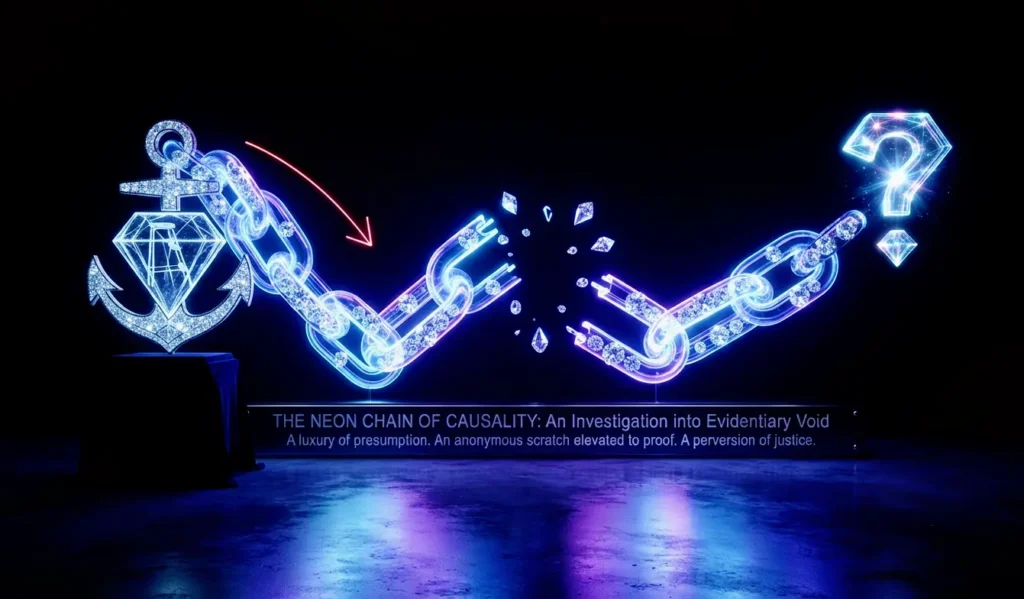
The conviction is built upon a fundamental logical failure: the assertion of causality without objective verification. The court assumes that the observed physical mark is a direct result of the alleged incident involving the ladder, bypassing the standard of proof.
There is no forensic evidence establishing a connection between the specific injury and the alleged ladder impact. A scratch is a non-specific injury that can result from numerous everyday household interactions. Its presence alone does not establish how, when, or by what object it was caused.
Prosecutor Tomas Niemitalo failed to establish a biological or forensic link proving the origin of the injury. The evidentiary gap concerns not merely the existence of a visible mark, but the absence of objective proof connecting that mark to the alleged act.
Judge Inga-Liisa Paavola treated the causal link as established, despite the absence of objective verification. By accepting the alleged connection without sufficient evidentiary support, the court raises a fundamental question concerning compliance with the presumption of innocence: was the prosecution required to prove the origin of the injury, or was the accused effectively required to disprove an assumed connection?
The photographic evidence lacks forensic markers, scales, anatomical orientation, timestamped metadata, and third-party medical validation. Accepting an unverified image of an unidentified limb as proof of a specific injury and its cause raises serious concerns about the reliability and sufficiency of the evidence.
Without reliable identification of the photographed body part, documented circumstances of image capture, and independent medical assessment, the photograph cannot by itself establish the alleged mechanism of injury.
Audit Conclusion
In the absence of a verified causal link, using unverified and unidentified photographic evidence to secure a criminal conviction undermines the integrity of the evidentiary process and raises serious questions about the administration of justice.
The circumstances warrant examination of whether the handling or use of evidence, if supported by proof of the requisite knowledge and intent, could engage the statutory provisions concerning falsification of evidence (Rikoslaki, Chapter 15, Section 7) and abuse of public office (Rikoslaki, Chapter 40, Section 7).
Forensic Legal Audit
The integrity of the judicial record is called into question by a substantial discrepancy in the recorded duration of the trial. While the Helsinki District Court, presided over by Judge Inga-Liisa Paavola, officially documented the proceedings as lasting 150 minutes, the audio evidence provided spans only 77 minutes.
A total of 73 minutes—nearly half of the officially documented 150-minute hearing—are absent from the audio files provided. This is not a minor difference in recording duration. It is a substantial gap in the available record of the proceedings.
The absence of more than an hour of trial audio cannot be dismissed as a trivial technical irregularity without a documented explanation. It creates an evidentiary vacuum concerning what occurred during the unrecorded period.
Crucial testimony, objections, procedural clarifications, or other material exchanges may have taken place during this interval. Without a complete recording or an equivalent reliable record, it is impossible to independently establish whether such matters were raised, how they were addressed, and whether they were accurately reflected in the official account of the proceedings.
The central issue is therefore not simply that the audio is incomplete, but that the missing portion prevents meaningful verification of the trial’s procedural history.
Prosecutor Tomas Niemitalo and the court personnel responsible for record-keeping were involved in proceedings for which the available audio provides only a partial account. The discrepancy raises questions about how the recordings were created, preserved, reviewed, and supplied.
Was the missing audio ever recorded? If so, what happened to it? If it was not recorded, what explains the absence of nearly half of the hearing from the audio record? And on what basis can the available files be treated as an adequate representation of the proceedings?
Surgical Audit Conclusion
A court record that accounts for only 77 minutes of a hearing officially documented as lasting 150 minutes raises a fundamental question about the completeness and reliability of the judicial record.
If a truncated audio file was presented as a complete account of the proceedings, the omission of material information would constitute a serious matter requiring investigation. The 73-minute discrepancy must be explained before the record can be treated as a reliable basis for assessing what occurred during the trial.
The circumstances also warrant examination of whether any deliberate alteration, concealment, or misuse of the record occurred and whether, if supported by evidence of the requisite knowledge and intent, such conduct could engage the statutory provisions concerning falsification of evidence (Rikoslaki, Chapter 15, Section 7) and abuse of public office (Rikoslaki, Chapter 40, Section 7).
Listen to the complete audio investigation as we draw the historical line from the 1819 Boorn brothers show trial straight into the modern evidentiary vacuum of The Victim-Criminal Flip Case R706/2025/5226, Finland. Discover how physical impossibilities, 100-year state secrecy stamps, and institutional cover-ups undermine the very core of judicial integrity.
LawBeat Radio
Independent legal media platform focusing on structural judicial monitoring and criminal case analysis. We examine international standards of justice, from the presumption of innocence to the rigorous evaluation of the standard of proof and in dubio pro reo principles.
Legal Disclaimer:
All analytical materials and legal case reviews on this website are published for informational and educational purposes only under freedom of expression. Content does not constitute professional legal advice.
© 2026 LawBeatRadio. All rights reserved.