
LawBeat Radio Technical Audit
The integrity of judicial proceedings relies entirely on the accuracy and completeness of the official record. When a forensic audit reveals a stark chronological discrepancy between the official court duration log and the provided digital audio files—coupled with stripped metadata and checksum conflicts—the foundational standards of transparency and the right to a fair trial are critically compromised. This analysis examines procedural irregularities and evidence tampering in Case R 706/2025/5226.
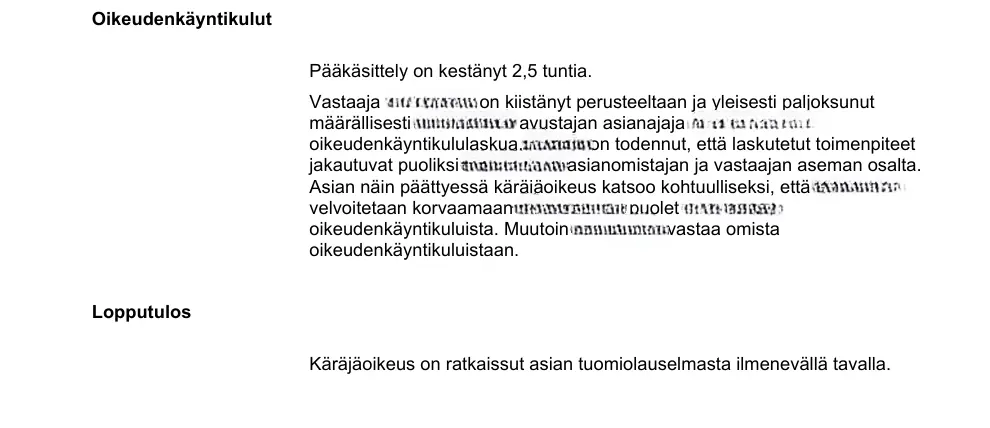
The official court verdict explicitly states that the main hearing in question lasted 2.5 hours (150 minutes) (“Pääkäsittely on kestänyt 2,5 tuntia”). However, a technical audit of the audio files issued by the Court presents a critical chronological inconsistency:
This profound gap raises an unanswerable question for judicial transparency: What occurred during the missing 73 minutes, and why does the digital archive fail to correspond with the court’s own official duration log?
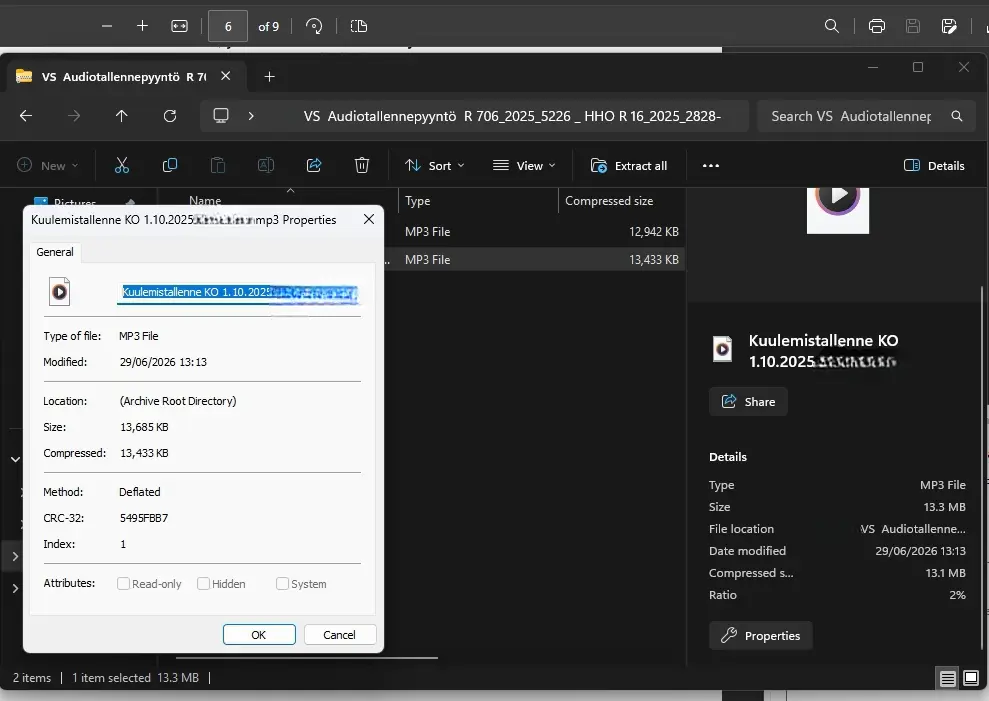
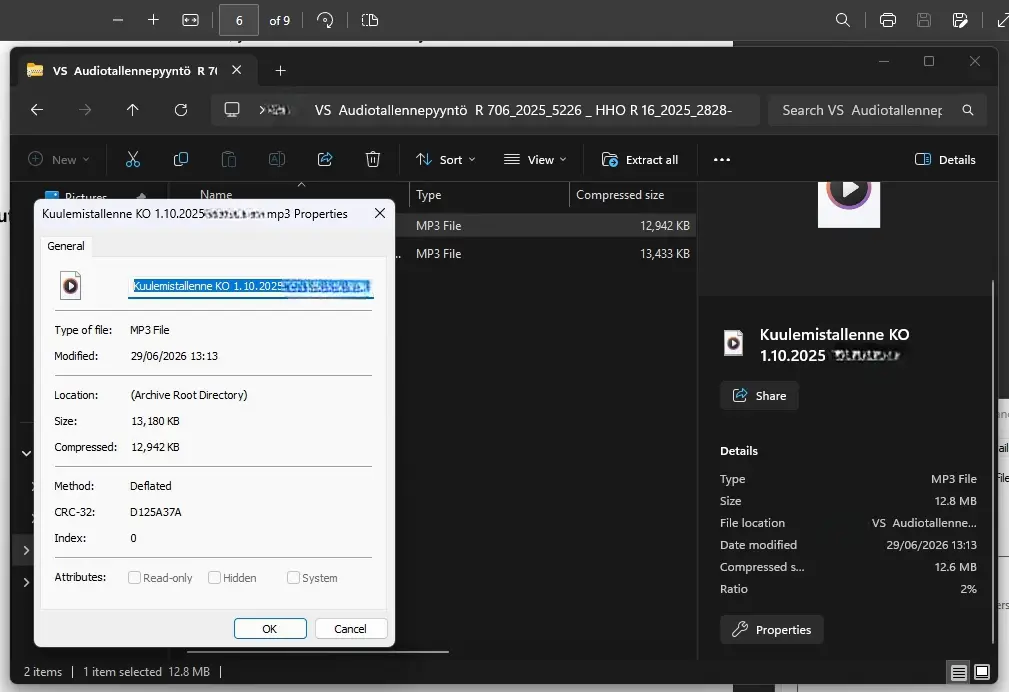
To assess provenance and authenticity, the provided audio files underwent rigorous forensic examination, yielding alarming indicators of data modification:
In any standard forensic process, the stripping of metadata and modification of checksums prior to defence delivery is an anomalous event that destroys chain of custody and evidence verifiability.
The reliability of evidence is the bedrock of any public hearing designed to deliver justice. The principles of RELIABILITY OF EVIDENCE and the STANDARD OF PROOF dictate that legal records must remain untampered, complete, and verifiable.
When the discrepancy between the official duration and the provided data is as stark as 73 minutes, public trust and judicial transparency demand an immediate accounting. Case R 706/2025/5226 illustrates a fundamental breakdown in evidence management, where the integrity of court-provided data has been demonstrably undermined. Unedited, raw source files must be made available to ensure that the record is beyond dispute.
Application Note:
Truncating audio timelines by 73 minutes while preserving conflicting checksums destroys the foundational reliability of evidence. Under in dubio pro reo, an incomplete and manipulated record cannot establish guilt beyond a reasonable doubt.
LawBeat Radio
Independent legal media platform focusing on structural judicial monitoring and criminal case analysis. We examine international standards of justice, from the presumption of innocence to the rigorous evaluation of the standard of proof and in dubio pro reo principles.
Legal Disclaimer:
All analytical materials and legal case reviews on this website are published for informational and educational purposes only under freedom of expression. Content does not constitute professional legal advice.
© 2026 LawBeatRadio. All rights reserved.