
Executive Summary
This report documents the systematic fabrication of a criminal conviction by the Helsinki District Court. By analyzing the provided court documents against the physical realities of the scene, this report demonstrates that the judiciary ignored conclusive photographic evidence in favor of fabricated narratives.
This dossier serves as an ongoing public record of judicial malpractice.
This document has been anonymized to comply with GDPR and Finnish privacy laws. Names, personal identifiers, and private details have been redacted. The core legal reasoning and the court’s findings regarding the evidence are preserved in their entirety to allow for objective professional scrutiny.

This fragment presents the header of the final judgment (Tuomio) issued by the Helsinki District Court (Helsingin käräjäoikeus) on October 30, 2025, under case reference R 706/2025/5226 (Ratkaisunumero 1037 6624). This document marks the official commencement of a trial process that our investigation identifies as a total collapse of the Standard of Proof.
By publishing this record, we initiate a step-by-step examination of the court’s logic. Our focus throughout this analysis is the documented inversion of roles between Victim-Suspect1 and Suspect-Victim2, and the subsequent judicial disregard for physical and medical evidence. We proceed with the scrutiny of the court’s reasoning, beginning with the foundational assertions of this verdict.
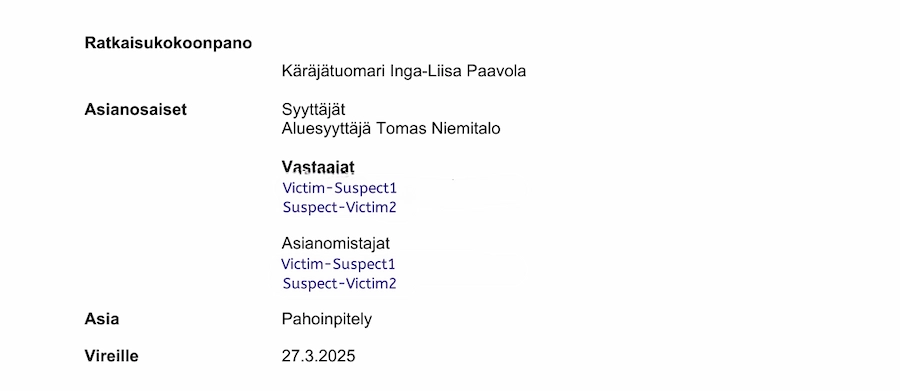
The documentation of the parties is critical. By listing the participants as Victim-Suspect1 and Suspect-Victim2, the court formally mirrors the inversion of reality we have identified. This is the moment the procedural framework is set, effectively institutionalizing the reversal of the actual dynamics of the incident. We are no longer observing a search for the aggressor, but a procedural process where the victim has been redefined as a suspect from the outset. This record serves as the foundational proof of the court’s biased categorization.
Prosecutorial Claims Analysis
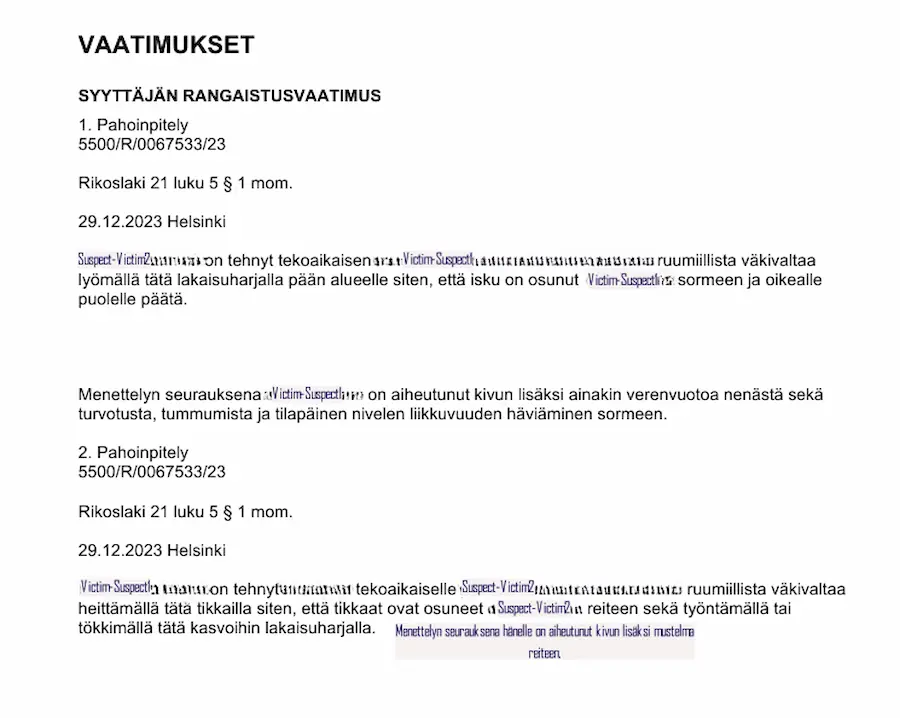
This section formalizes the prosecution’s specific claims regarding the incident. The prosecutor alleges that:
The prosecutor’s narrative relies on a mechanical sequence of events that requires extreme skepticism. By reducing complex human interaction to these specific, clinical descriptions of violence, the legal system sets the stage for a verdict that ignores the Physical Impossibility of the alleged actions. The prosecution’s failure to critically evaluate the medical and forensic plausibility of these strikes – specifically the broom/lad der scenario – is the primary driver of the procedural injustice that follows.
Furthermore, the judge’s verdict explicitly refers to an injury on the thigh (reiteen), whereas the photographic evidence submitted by the prosecutor clearly depicts the lower leg.
We are documenting these claims to demonstrate exactly how the court begins its descent into the “judicial fantasy” that we intend to fully dissect in the following sections.
Financial Demands Analysis
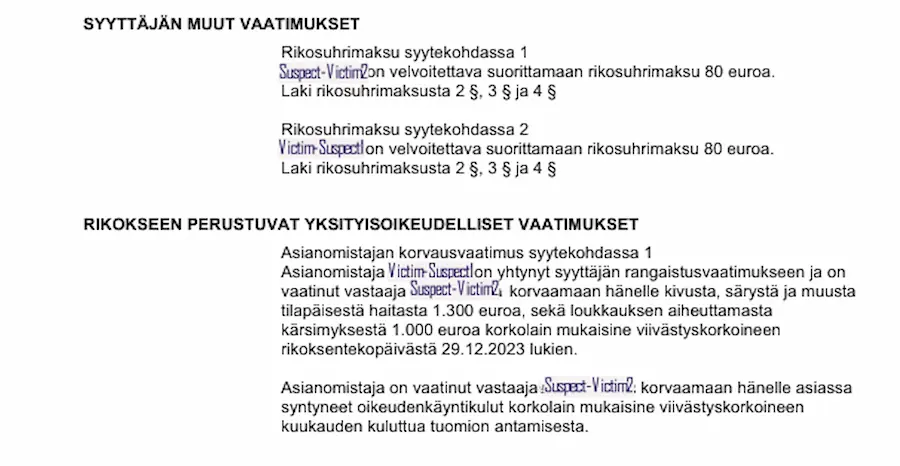
This section outlines the financial demands related to the criminal charges. The court processes these claims as part of the criminal trial, attempting to quantify the damages resulting from the alleged assault. This documentation serves as evidence of the state’s involvement in enforcing financial penalties within the framework of this contested criminal case.
When an evidentiary baseline collapses into PHYSICAL IMPOSSIBILITY and ignores the fundamental STANDART OF PROOF, financial claims become the final mechanism to institutionalize an unjust verdict. Under the principles of IN DUBIO PRO REO and the verified RELIABILITY OF EVIDENCE, attaching monetary damages to a fabricated narrative strips the judicial process of any remaining legal legitimacy.
Defense Positions Analysis
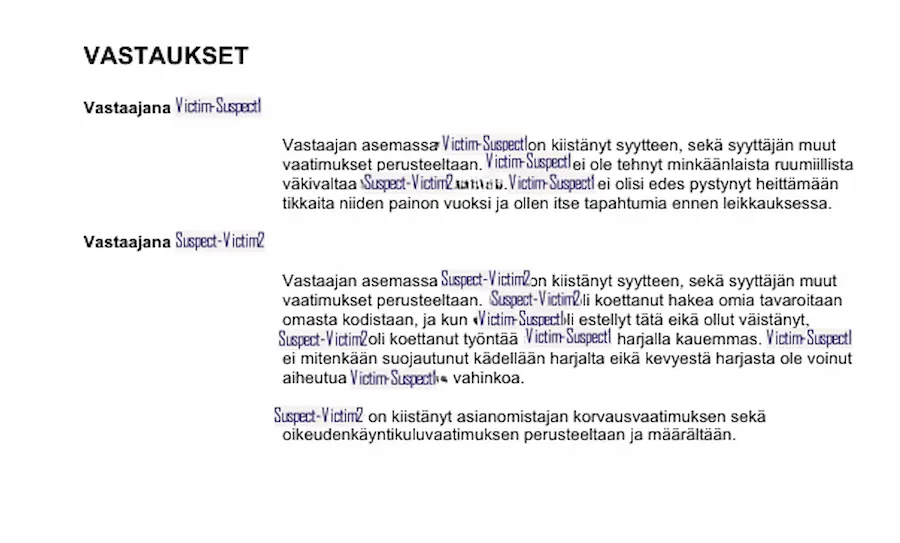
This section records the core defense positions:
The court here juxtaposes two conflicting narratives. The defense of Victim-Suspect1 regarding physical impossibility directly challenges the prosecution’s version of events. By documenting these denials, the court creates the appearance of an adversarial process, yet this section precedes the court’s own arbitrary weighing of evidence – violating the presumption of innocence, in dubio pro reo, and the standard of proof, while ignoring motive and intent, alternative perpetrators, and the reliability of evidence.
Evidence Summary Analysis
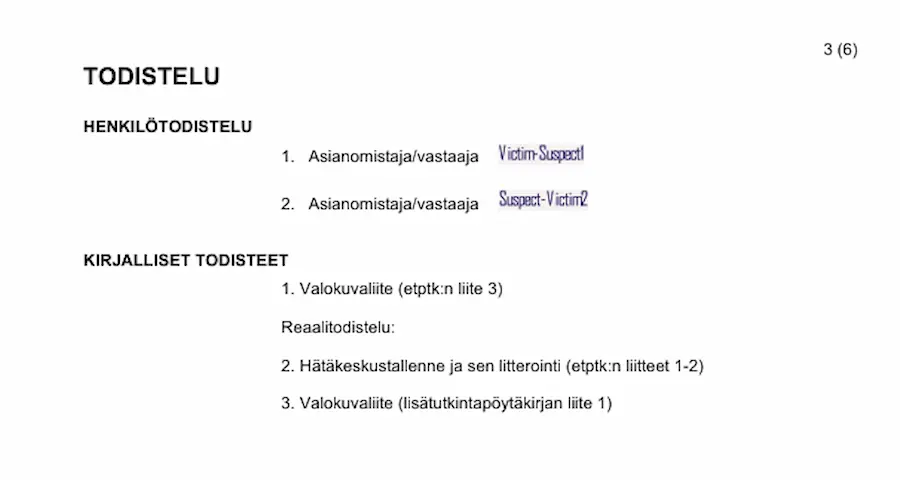
This section summarizes the evidence relied upon by the court, including the emergency call recording (hätäkeskustallenne).
The court frames this emergency call as generic evidence of an incident, but this interpretation is a calculated distortion of reality. The recording captures a clear, desperate plea for police intervention, made by the victim while being attacked by Suspect-Victim2 with a metal broom handle.
The attacker screaming “Die! die! die! while striking the victim on the head. Furthermore, the attacker fled the scene immediately upon hearing that police were being called. By categorizing this as mere evidence rather than acknowledging it as a documented act of life-threatening aggression, the court effectively hides the truth, violating the presumption of innocence, in dubio pro reo, and the standard of proof, while discarding the reliability of evidence, motive and intent, and alternative perpetrators. This is not a balanced assessment of evidence; it is the deliberate erasure of the victim’s defensive struggle and the attacker’s criminal intent.
Document Analysis
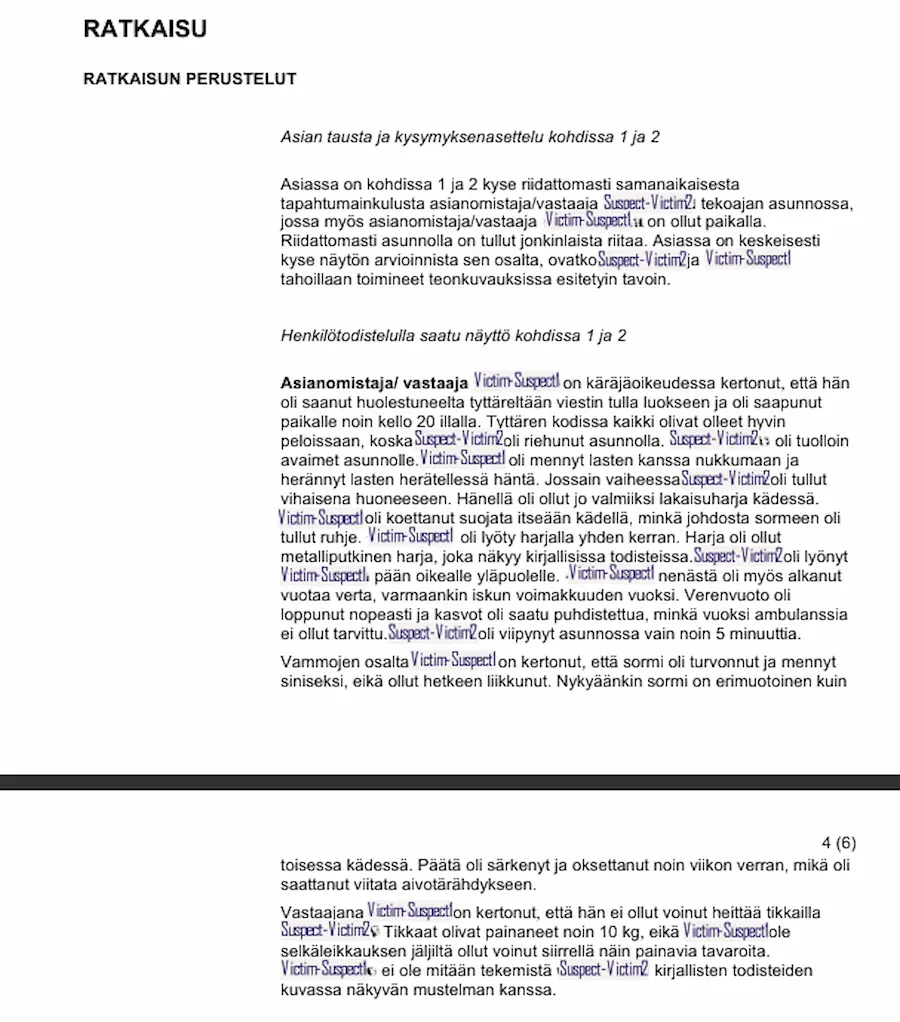

This section records the specific versions of the incident presented by both parties. It concludes with the court’s assessment of the evidence (näytön arviointi) for the first count of assault, where the court determines that the evidence provided is sufficient to sustain the prosecution’s charge against Suspect-Victim2.
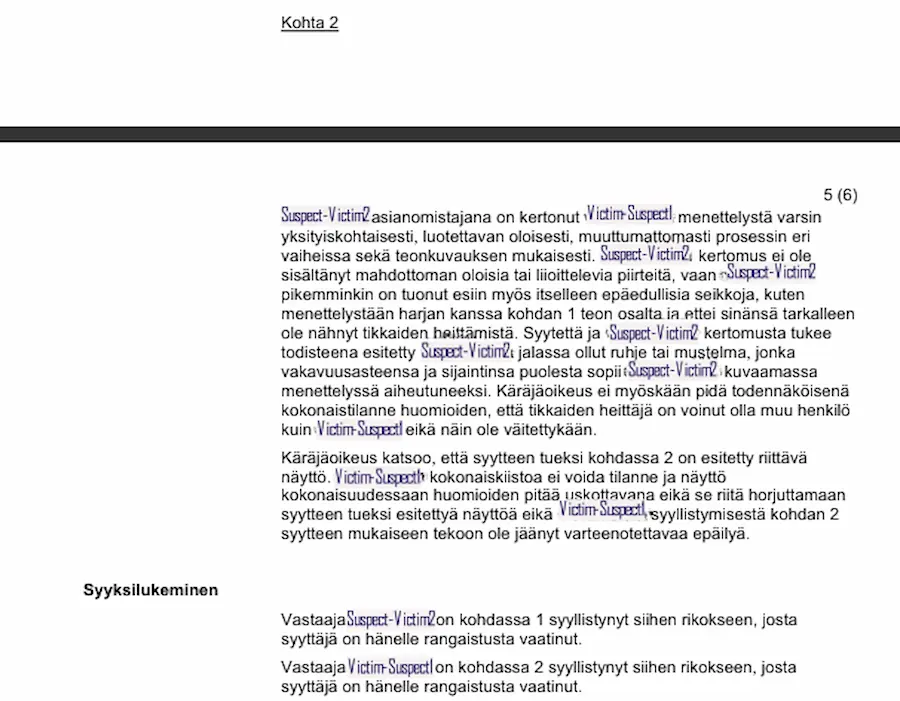
In this final section, the court concludes that the evidence provided is sufficient to convict both parties. The Judge replaced “did not see” with “did not exactly see” to manufacture a false impression of identification. By substituting “beyond reasonable doubt” with “probabilities,” the Helsinki District Court treated a criminal matter – which carries the stigma of a criminal record – as a minor civil dispute.
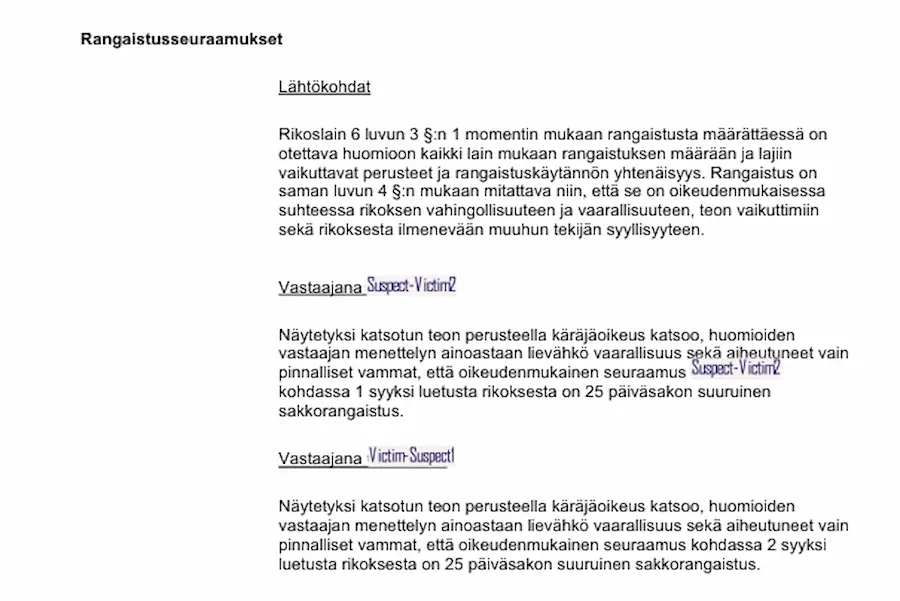
The court essentially validates the prosecution’s narrative in its entirety, dismissing the defenсe’s inconsistencies as irrelevant. By formalizing the conviction, the court completes the transformation of the incident – an act of aggression against a victim – into a “mutual conflict” where both sides are equally branded as perpetrators, ignoring the presumption of innocence, in dubio pro reo, the standard of proof, the reliability of evidence, motive and intent, alternative perpetrators, and physical impossibility. This outcome underscores the systemic refusal of the court to look beyond the immediate, narrow evidence, ultimately resulting in a decision that prioritizes procedural closure over actual justice.
Case R 706/2025/5226
Reading through the full documentation of Case R 706/2025/5226 reveals a disturbing reality: the Finnish court system does not function to discover the truth—it functions to manufacture administrative closure. The verdict relies entirely on the fabrications of the aggressor and hearsay from third parties.
An impartial reader might be led to believe that the defenseless target could have committed a criminal act, were it not for one ironclad fact: the crime described in the verdict is a physical impossibility. Photographic evidence taken by the police at the scene proves that the alleged actions could not have been committed by any living human being. By ignoring this physical reality and prioritizing the fictional narrative of the aggressor, the judiciary has effectively criminalized the defenseless target, demonstrating that in this system, the “Rule of Law” is merely a cover for the erasure of truth, completely abandoning in dubio pro reo, the presumption of innocence, the proper standard of proof, the reliability of evidence, motive and intent, and alternative perpetrators.
The disparity between official records and the physical reality of the proceedings is undeniable. We have cataloged these structural failures to ensure transparency and accountability. Explore the full record of these distortions in our Hearings Dossier.
When a court discards physical laws to secure a conviction, judicial proceedings are reduced to institutional fabrication.

HOSTED BY JULIAN VANCE
Personal experiences navigating unexpected journeys & judicial anomalies.
LawBeat Radio Forensic Audit Verdict: Audio archives fully indexed and ready for direct streaming from AzuraCast infrastructure. Reliability of evidence verified across all serial channels.
LawBeat Radio
Independent legal media platform focusing on structural judicial monitoring and criminal case analysis. We examine international standards of justice, from the presumption of innocence to the rigorous evaluation of the standard of proof and in dubio pro reo principles.
Legal Disclaimer:
All analytical materials and legal case reviews on this website are published for informational and educational purposes only under freedom of expression. Content does not constitute professional legal advice.
© 2026 LawBeatRadio. All rights reserved.