
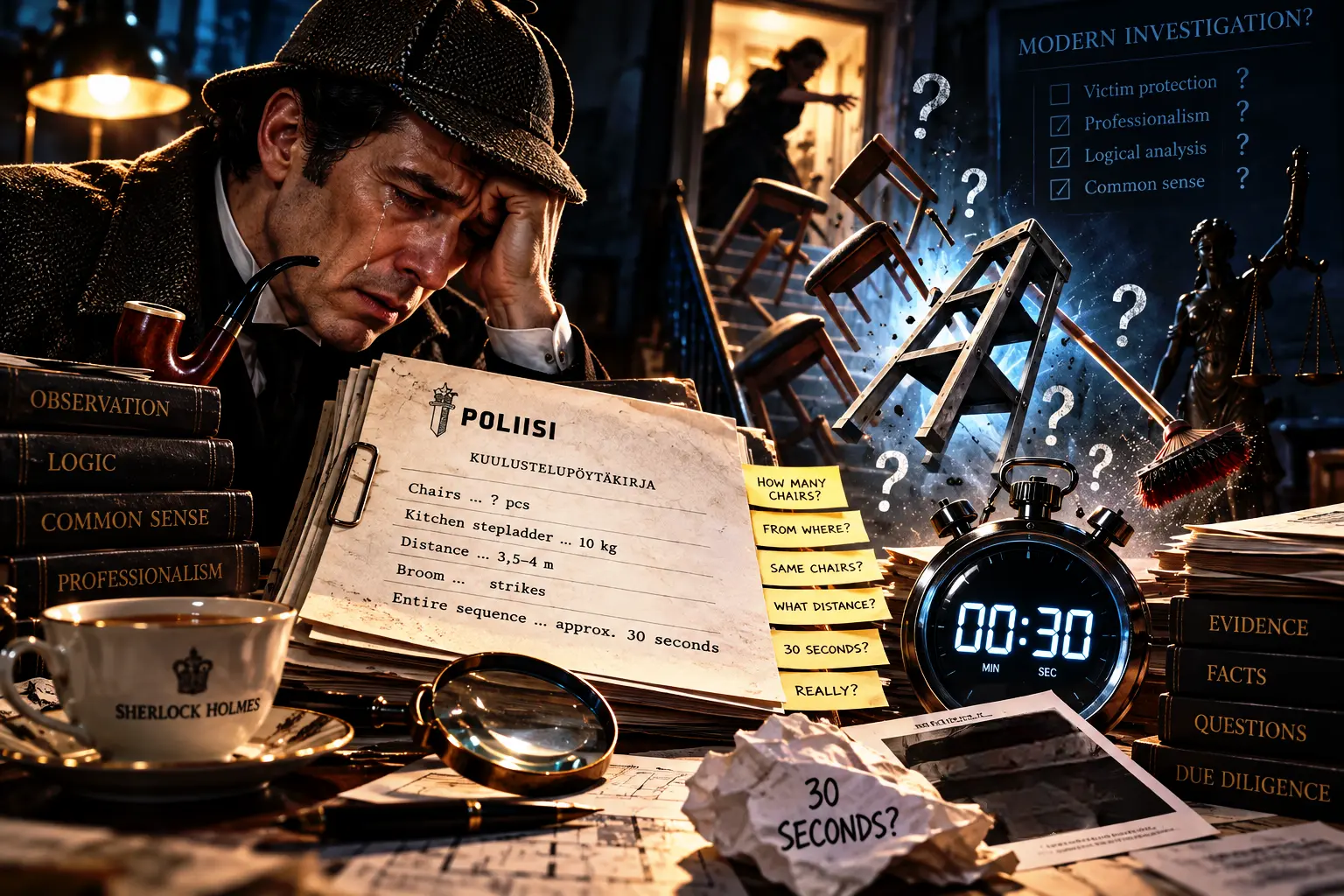
How does a person initially treated as the injured party become a suspect in the same case? In the Victim–Suspect Flip Case (R 706/2025/5226), that question leads back to the pre-trial investigation, the account available to the investigator, the stated time of the incident, and the evidence used to support the counter-allegation against TG.
This is a documentary audit of the investigative process. It begins with the account that was available before trial and asks what was verified, what remained unexplained, and what the case file actually establishes.
Four additional questions were appended to the interrogation. Four questions — and the case remained open.
TG was initially questioned at the police station as the injured party in the assault reported on 29 December 2023.
On 24 April 2024, the interrogation record contains a pre-printed statement that TG had been informed of her rights and was being questioned as a suspect. But where is the recorded exchange establishing that this change of procedural status was explained to her? Where is the question confirming that she understood the change? And where did TG state that she agreed to proceed without a lawyer?
The document contains the standard formula. It contains no recorded answers establishing TG’s understanding of the change in status or her decision concerning legal assistance.
Then came the next seventeen months and seven days before trial.
Where is the documented investigative work? Where are the additional witness interrogations? Where are the newly collected items of evidence? Where is the documented verification of the competing accounts? Where is the record of an investigative visit to the scene?
In the materials available for this audit, no such investigative steps have been identified.
The interrogation record documents the allegations put to TG and her denials. Yet the central allegation against her raises elementary questions about the sequence of events, the position of the people involved, the alleged object, and whether the described actions could have occurred as claimed.
Those questions called for investigation, not merely another set of questions appended to an interrogation record.
One year, five months, and seven days is a substantial amount of time. What was it used for?
The available materials show the counter-allegation being pursued. Where is the documented work that tested it? Where are the records of further evidence collection, witness interviews, or examination of the scene? What investigative foundation supported the counter-allegation as the case proceeded towards trial?
This is the investigator’s peculiar achievement, as the documents examined here present it: a counter-allegation was pursued, but the record contains no identified investigative steps demonstrating how its factual basis was tested.
Four questions added at the end. An open case. One year, five months, and seven days before trial.
A remarkably long interval — and remarkably little documented investigative activity in the materials examined.
The question is not simply why TG became a suspect. It is what, if anything, the documented investigation established about whether the accusation against her was true.
The photograph shows a small, localised discolouration on a section of skin. It does not show a face. It does not show the entire leg. The anatomical orientation is not independently established by the image alone. The photograph itself does not establish whose body part is depicted, when the mark appeared, or what caused it.
Yet the allegation concerned a specific person, a specific incident, a specific object, and a specific anatomical location.
A photograph of a mark is one thing. Proof that the mark belonged to N, resulted from the alleged incident, and was caused by TG is quite another.
The Criminal Investigation Act requires the circumstances of the suspected offence to be clarified and evidence both against and in favour of a suspect to be considered.
So the question is straightforward:
What independently established facts connected this unidentified section of skin to the alleged assault by TG?
A label is not an identification method. An allegation is not proof of causation. And a photograph cannot answer questions that it does not actually show.
Let us look at the photograph itself.
Where is the face?
Where is the foot?
Where is the knee, or any other anatomical landmark that would allow the viewer to establish whether the image shows a thigh or a lower leg?
Where is the rest of the body?
The photograph presents only a small fragment of skin with a couple of superficial-looking marks. From the image alone, the person cannot be identified, the exact anatomical location cannot be established with confidence, and the origin of the marks cannot be determined.
There is no visible identifier connecting this fragment of a body to N. There is no visible evidence establishing when the marks appeared, what caused them, or whether they resulted from the alleged incident.
And yet this image became part of the case against TG.
What, precisely, was the investigator able to establish from this photograph?
Not whose body part it was. Not the exact location of the marks. Not their origin. Not their connection to the alleged act.
The photograph does not answer those questions.
Our opinion is straightforward: this image cannot, by itself, establish the facts required to prove the allegation against TG. Treating it as if it did would mean substituting an assumption for identification, and an unexplained mark for proof of a specific act.
Taken to its absurd conclusion, this approach would make almost anyone a potential criminal.
One could obtain a photograph of an unidentified patch of skin, take it to the police, and claim that it showed an injury caused by a particular person. If nobody established whose body part appeared in the image or what the marks had to do with the alleged event, the accusation would rest on an assumption.
A neighbour’s photograph could become somebody else’s criminal case.
If this is what passes for establishing evidence, then practically anyone could be turned into a suspect by presenting a photograph of an unidentified piece of somebody’s body.
That is the absurdity we are exposing.
The time and date of an alleged crime are fundamental facts. They determine whether a person could have committed the alleged act, where that person was at the relevant moment, and what evidence may support their defence. When the chronology crosses midnight, the date matters just as much as the hour.
The emergency call concerning the incident was registered on 29 December 2023 at 04:55:35 a.m. TG was the injured party in the incident reported to the police. N was subsequently questioned by telephone as a suspect in connection with that incident.
During his interrogation, the investigator asked N when he had returned to the apartment. N answered that it had been 5:00 p.m. — adding that this was 10–15 minutes before the emergency call recorded on 29 December at 04:55 a.m.
In the same interrogation, N described the incident and attributed actions to TG, forming the basis of the counter-allegation against her. The record contains his answer, but no clarification resolving the difference between the time he gave and the documented emergency-call timestamp.
TG was later questioned, her interrogation record contains no question asking where she had been at 5:00 p.m.
N’s account places the alleged confrontation on the evening of 28 December. The emergency call was recorded in the early hours of 29 December. The investigator recorded both parts of the account without a documented clarification — and the counter-allegation against TG proceeded.
According to N’s pre-trial interrogation, the entire episode — from the beginning of the confrontation until he retrieved his headphones and left — lasted approximately thirty seconds.
Let us look at what he says happened during those thirty seconds.
N describes returning to the apartment and finding a stairway obstructed by chairs. He says he began clearing the obstruction. He then alleges that TG threw chairs at him, including while he was clearing the passage.
How many chairs were there? The interrogation record does not specify a total number.
Were the chairs he was clearing the same chairs TG was allegedly throwing, or were these additional chairs? If they were different chairs, how many were involved altogether? Where were they located before the alleged throwing began? From what distance were they allegedly thrown?
The investigator recorded both the clearing of the obstruction and the alleged throwing of chairs. Yet the number of chairs and the sequence in which they were supposedly used remain unspecified.
Apparently, the chairs were important enough to feature twice in the account, but not important enough to count.
N describes the kitchen stepladder as heavy, weighing approximately 10 kilograms. He alleges that TG threw it at him and that it struck his leg.
Asked how far TG threw it, N answers that the distance from above to below was approximately 3.5–4 metres.
That is the measurement recorded in his statement. But what, precisely, does it describe in the physical sequence? The statement refers to a distance from above to below, but does not provide a measured reconstruction of the positions involved.
Where was TG when she allegedly threw the stepladder? Where was N? What was the distance between them? How does the stated 3.5–4 metres relate to the alleged throw and the impact to his leg?
The investigator recorded a number. The record does not establish the complete spatial context needed to assess the action described.
N alleges that TG struck him in the face with a broom five times.
From what distance were these alleged strikes delivered? The account does not provide a measured distance for the broom strikes. Nor does it establish how that distance related to the 3.5–4 metres mentioned in connection with the stepladder.
A broom is not a ten-kilogram stepladder. The distance given for one alleged action cannot simply be applied to another. Yet the record does not provide the spatial details needed to examine the sequence.
According to N, he took the broom from TG, struck her on the head, retrieved his headphones, and left.
All of these actions belong to the same sequence that he estimated at approximately thirty seconds.
So let us put the account together: clearing a stairway obstruction; chairs allegedly being thrown; a kitchen stepladder weighing approximately ten kilograms allegedly thrown from above to below over a stated distance of 3.5–4 metres; five alleged broom strikes; a struggle over the broom; a blow to the head; and finally, the retrieval of headphones and departure.
Thirty seconds. All of it.
How many chairs? Not specified.
Where were the chairs before they were allegedly thrown? Not specified.
Were the chairs being cleared the same chairs that were allegedly thrown? Not clarified.
From what distance were the chairs allegedly thrown? Not specified.
What exactly did the 3.5–4-metre measurement represent in the stepladder episode? The statement gives a distance from above to below, but no complete measured reconstruction.
From what distance were the five alleged broom strikes delivered? Not specified.
And how were all these actions sequenced within approximately thirty seconds? The account gives a duration, but the interrogation record does not document a measured reconstruction of the sequence.
This is where the investigator’s work becomes remarkable. She recorded a complicated chain of physical actions, including multiple alleged attacks with different objects, yet the record leaves basic questions about quantities, distances, positions, and sequence unanswered.
And thirty seconds is not an abstract unit of time when a person is expected to perform several separate physical actions. It is half a minute.
Was the investigator able to establish that the entire sequence described by N could realistically have occurred within that interval? The interrogation record does not document such an assessment.
For a person of TG’s age, the question is even more immediate: what exactly was she supposed to have accomplished in those thirty seconds — and on what documented basis did the investigator accept that account without clarifying the missing physical details?
Five broom strikes. Chairs appearing in two different roles. A ten-kilogram stepladder. A struggle. A blow to the head. Headphones retrieved. Departure.
Thirty seconds.
A remarkably efficient action sequence. The choreography is elaborate; the documented reconstruction is missing.
For professional development and future reference
The following provisions of Finnish law set out the principles and requirements relevant to the investigation of an allegation, the assessment of competing accounts, and the documentation of investigative work. They are cited here as a reminder of the applicable legal framework, not as a conclusion that any provision was breached.
The investigation must clarify the suspected offence, the circumstances in which it was committed, the damage caused, the parties involved, and other circumstances necessary for the consideration of prosecution and the consequences of the offence.
Relevance to this audit: An account involving chairs, a kitchen stepladder, five alleged broom strikes, a struggle, and a claimed total duration of approximately thirty seconds raises factual questions about the sequence and circumstances of the alleged acts.
The parties and the circumstances being investigated must be treated impartially. Evidence and circumstances must be considered without favouring one side.
Relevance to this audit: The investigative framework requires attention to the circumstances that support an allegation and those that may call it into question.
The procedural status of a person must be determined in accordance with the law and the circumstances of the investigation.
Relevance to this audit: Where an account given by one person leads to an allegation against another, the procedural basis for investigating that allegation belongs to the documented investigative process.
The interrogation record must be made available for review after questioning. The person questioned must be asked whether their statement has been recorded correctly, and relevant requested additions and corrections must be entered in the record.
Relevance to this audit: An interrogation record is a formal record of what was documented during questioning. Its contents and omissions matter when the account is later used in the proceedings.
The criminal investigation record must include interrogation records, accounts of investigative measures, relevant observations, and documents, recordings, and photographs collected during the investigation, subject to the statutory requirements.
Relevance to this audit: The documented basis for an allegation and the investigative steps used to examine it should be traceable through the investigation materials.
These provisions provide the legal framework for examining the questions raised by the thirty-second account: what was alleged, what was clarified, what investigative measures were documented, and what factual basis was established before the counter-allegation proceeded.
LawBeat Radio
Independent legal media platform focusing on structural judicial monitoring and criminal case analysis. We examine international standards of justice, from the presumption of innocence to the rigorous evaluation of the standard of proof and in dubio pro reo principles.
Legal Disclaimer:
All analytical materials and legal case reviews on this website are published for informational and educational purposes only under freedom of expression. Content does not constitute professional legal advice.
© 2026 LawBeatRadio. All rights reserved.