
==================================================
LEGAL MEMORANDUM // INDEPENDENT CASE REVIEW
==================================================
TO: Case File & Analytical Archive
FROM: Independent Legal Analyst
DATE: August 23, 2026
RE: Cat Tree vs. Flying Chair: A Physics Review
==================================================
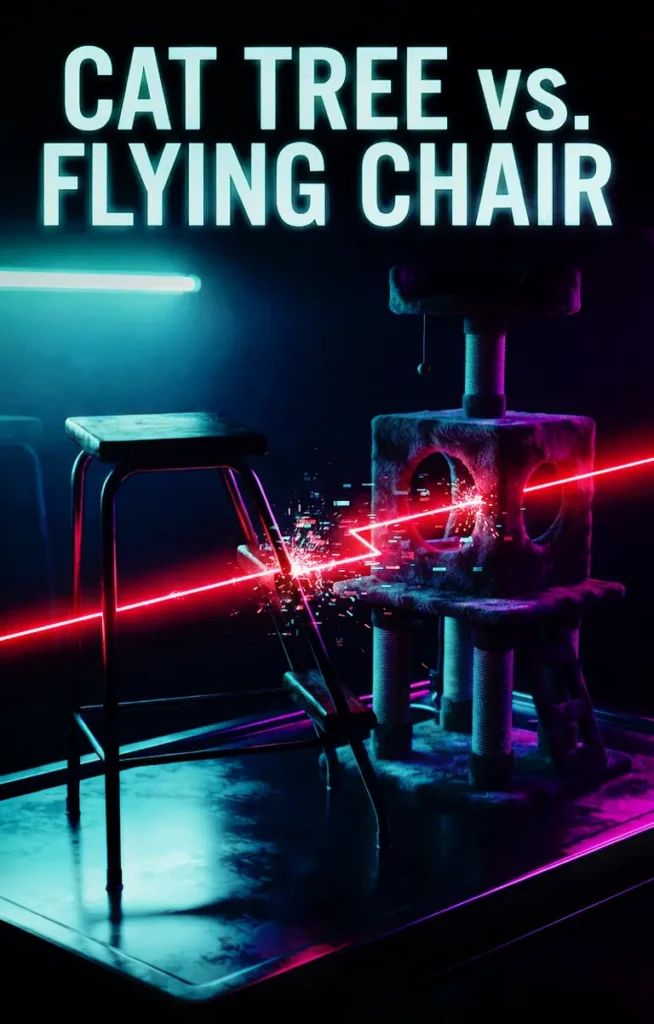
In this analytical review Cat Tree vs. Flying Chair, does a judicial verdict retain legal reliability and satisfy the criminal standard of proof when the physical mechanism of the alleged injury directly contradicts the laws of trajectory, objective scene geometry, and anatomical location, thereby violating the presumption of innocence and in dubio pro reo?
Cat Tree vs. Flying Chair. A ruthless IRAC review tearing apart a fabricated judicial narrative.
Technical Analysis of the Incident Scene: The entire conviction relies on the accuser’s shifting testimony, which directly violates the laws of trajectory, spatial dimensions, and the objective reality documented in police evidence logs.
Cat Tree vs. Flying Chair. A ruthless IRAC review tearing apart a fabricated judicial narrative.
Forensic Audit of Photographic Exhibits: The prosecution introduced a low-grade photograph of a shin bruise as alleged “proof” of the assault. This exhibit fails every basic legal and forensic threshold, directly sabotaging the required reliability of evidence.
Furthermore, the systemic failure to authenticate visual exhibits establishes a dangerous precedent of unverified judicial acceptance. When digital or physical representations of injuries are admitted into the official record without a chain of custody, time stamps, or professional medical attestation, the integrity of the judicial process is entirely compromised. A court cannot lawfully substitute forensic certainty with generalized visual assumptions without reducing the standard of proof to an arbitrary exercise of subjective discretion.
A rigorous audit of Case R 706/2025/5226, presided over by Judge Inga-Liisa Paavola, exposes a profound, fatal disconnect where the official written judgment completely diverges from the underlying evidentiary record:
This fatal anatomical contradiction exposes the utter collapse of judicial due diligence. The prosecution’s written verdict formally convicts based on an alleged impact to the thigh (*reiteen*), yet the sole evidentiary exhibit—a rudimentary, unauthenticated WhatsApp snapshot—depicts an entirely different anatomical zone: the shin (*säären*). To sentence a defendant for a kinetic action on one part of the body while resting the entire proof of guilt on an anonymous bruise located somewhere else is not a legal error; it is an absolute systemic failure. When a court cannot even correctly identify or match the body part allegedly impacted, the entire evidentiary framework dissolves into pure fiction.
The judicial findings collapse entirely under the crushing weight of physical impossibility and systemic evidentiary fraud. By discarding objective spatial reality, anatomical facts, and verifiable physics in favor of an unverified narrative fiction, the Court breached the foundational tenets of justice—including in dubio pro reo, the presumption of innocence, and the strict criminal standard of proof. A verdict built upon geometric anomalies, anatomical contradictions, and anonymous bruises is legally void and analytically bankrupt.
Cat Tree vs. Flying Chair. A ruthless IRAC review tearing apart a fabricated judicial narrative.
==================================================
==================================================
The judicial logic has failed. The record is preserved, the physics exposed, and the countdown to the appellate defenсe continues.
Listen to the complete audio investigation as we draw the historical line from the 1819 Boorn brothers show trial straight into the modern evidentiary vacuum of The Victim-Criminal Flip Case R706/2025/5226, Finland. Discover how physical impossibilities, 100-year state secrecy stamps, and institutional cover-ups undermine the very core of judicial integrity.
LawBeat Radio
Independent legal media platform focusing on structural judicial monitoring and criminal case analysis. We examine international standards of justice, from the presumption of innocence to the rigorous evaluation of the standard of proof and in dubio pro reo principles.
Legal Disclaimer:
All analytical materials and legal case reviews on this website are published for informational and educational purposes only under freedom of expression. Content does not constitute professional legal advice.
© 2026 LawBeatRadio. All rights reserved.