
Forensic Audit • The Wall-Eyed Witness
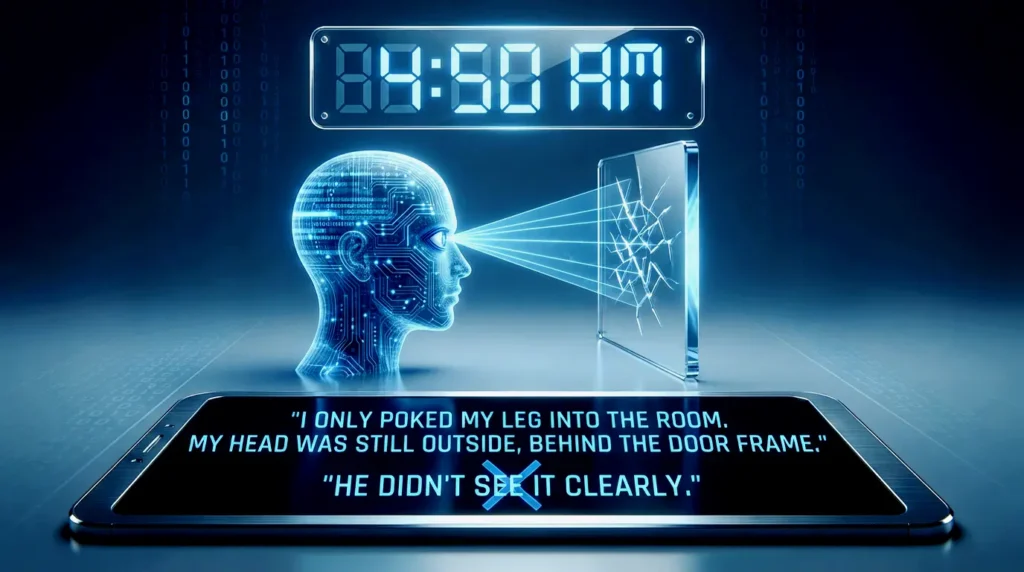
If the witness did not see the alleged throw, what exactly did he observe — and what did he infer?
The trial testimony describes a specific sequence of events. N stated that the heavy ten-kilogram oak-and-metal stepladder came from above and struck his leg. He then raised his head and saw TG standing on the upper landing with a broom in her hand.
But when counsel asked the direct question — whether he had actually seen her throw the heavy ten-kilogram oak-and-metal stepladder — N answered:
“I did not see it.”
That distinction matters. The testimony separates what N observed from what he later inferred.
According to his own account, N had only inserted his leg into the narrow entrance area when the ladder struck it. His head remained outside the doorway.
He then raised his head. At that point, he said, he saw TG standing above him with a broom in her hand.
“I only put my leg into the room. My head was still outside, behind the door frame. If my head had been inside, the object would have hit my head.”
This creates a precise evidentiary question. If N’s head was still outside the doorway when the impact occurred, and he expressly stated that he did not see the throw, then his later identification of the alleged thrower was not based on direct observation of the act itself.
After answering that he did not see the throw, N explained why he nevertheless considered TG to be the person who had thrown the ladder: in his view, it would be logical to assume that she had done so because he saw her standing above him immediately afterward.
That is an inference from the surrounding circumstances. It is not the same thing as seeing the act itself.
Forensic Distinction
Observation: the heavy ten-kilogram oak-and-metal stepladder struck his leg; he raised his head and saw TG above him with a broom.
Inference: it was therefore logical to assume that TG had thrown the heavy ten-kilogram oak-and-metal stepladder.
The account also has to be tested against the physical environment described in the record. N described a narrow entrance, with chairs placed behind the door. The police photograph shows additional structures above and around the doorway, including the large cat-tree structure directly over the upper area.
The alleged object was not described as a small or easily handled item. N described the kitchen ladder as heavy, approximately 10 kilograms, and made of solid oak.
The question is therefore not whether a particular physical sequence should simply be declared “impossible.” The question is whether the evidence establishes how that sequence could have occurred in the confined and obstructed space shown in the record — including the transition from the alleged throw to the moment when TG was already standing above him with the broom in her hand.
LawBeatRadio Forensic AuditThe critical issue is not whether N’s inference was conceivable. It is whether the written judgment preserved the distinction between what he actually saw and what he inferred.
He expressly stated that he did not see the heavy ten-kilogram oak-and-metal stepladder being thrown. His own account places his head outside the doorway at the moment of impact. Only afterward did he raise his head and see TG standing above him with a broom.
That distinction is not a matter of style. It goes directly to the evidentiary meaning of the testimony.
The issue begins with N’s own description of his position at the moment of impact. He stated that he had inserted his leg into the narrow entrance area while his head remained outside, behind the door frame. He then said that the ladder struck his leg.
He did not describe seeing the ladder being thrown. When counsel asked him directly whether he had seen the throw, he answered:
“I did not see it.”
Only after the impact, according to his account, did he raise his head. At that point he said he saw TG standing above him with the broom in her hand.
This creates a precise distinction between observation and inference.
What N said he observed
The ladder struck his leg. He raised his head. He then saw TG standing above him with a broom in her hand.
What N inferred
Because TG was standing above him after the impact, he considered it logical to assume that she had thrown the heavy ten-kilogram oak-and-metal stepladder.
Those are not the same evidentiary proposition. The first concerns what the witness says he directly perceived. The second is his conclusion drawn from the circumstances.
N also explained why he believed his position mattered. He said that if he had entered the apartment head-first, the heavy ten-kilogram oak-and-metal stepladder would have struck his head. In his account, therefore, his head had not yet crossed into the relevant area when the heavy ten-kilogram oak-and-metal stepladder struck his leg.
“If I had entered the apartment head-first, the heavy ten-kilogram oak-and-metal stepladder would certainly have hit my head.”
This matters because the position of the head determines the position of the eyes and therefore the available line of sight. The testimony itself places the witness’s head outside the doorway at the moment of impact — followed only afterward by his raising his head and seeing TG above him.
The significance of this distinction becomes critical when the trial testimony is compared with the wording used in the written judgment.
The testimony contains an explicit answer: he did not see the throw.
If the judgment instead characterizes the testimony as meaning that he merely did not see the event clearly, the difference is substantial. “Did not see” describes the absence of direct visual observation. “Did not see clearly” describes a limited or imperfect observation.
The forensic question
Was the distinction between non-observation and unclear observation preserved in the judgment?
LawBeatRadio Forensic AuditThe issue is not whether N’s inference was reasonable or unreasonable. The issue is whether the record preserved the boundary between what he actually saw and what he concluded from what he saw afterward.
When a witness expressly says that he did not see the critical act, the exact wording used to describe that testimony matters.
A single change in wording can change the evidentiary proposition from absence of observation to imperfect observation.
That is precisely the distinction this audit examines.
The distinction is small in wording but substantial in evidentiary meaning.
“I did not see it” describes a failure to observe the critical act.
“I did not see it clearly” describes something different: an observation that existed, but was incomplete, blurred or uncertain.
That difference matters particularly here because N did not merely describe an unclear view. When asked directly whether he had seen TG throw the ladder, he answered that he had not seen it.
The record therefore raises a precise question about judicial wording: was a complete absence of direct observation converted into an imperfect observation by the language of the judgment?
A court is entitled to assess testimony and draw conclusions from evidence. But the assessment still depends on an accurate account of what the witness actually said.
Here, the evidentiary boundary is unusually clear:
The witness’s direct answer
He did not see the heavy ten-kilogram oak-and-metal stepladder being thrown.
The witness’s subsequent inference
He considered it logical to assume that TG had thrown it because he saw her above him after the impact.
The judicial wording under examination
Whether the judgment preserved that distinction, or instead described the testimony as an unclear observation, is a matter that can be tested directly against the trial record.
The issue is therefore not whether a judge may interpret evidence. Of course the court must assess evidence.
The issue is narrower — and more fundamental:
Can a court change the evidentiary meaning of testimony by changing the wording used to describe it?
If the original testimony says that the witness did not see the act, replacing that proposition with one suggesting that he saw it but not clearly would not be a merely stylistic adjustment. It would change the evidentiary proposition being evaluated.
LawBeatRadio Forensic AuditThe court does not need to agree with a witness. It may reject a witness’s account, accept it, or draw inferences from it.
But there is a prior requirement:
The testimony must first be represented accurately.
That is why one apparently small word can matter so much. The question is not whether the wording sounds similar. The question is whether it preserves the same evidentiary meaning.
Listen to the complete audio investigation as we draw the historical line from the 1819 Boorn brothers show trial straight into the modern evidentiary vacuum of The Victim-Criminal Flip Case R706/2025/5226, Finland. Discover how physical impossibilities, 100-year state secrecy stamps, and institutional cover-ups undermine the very core of judicial integrity.
LawBeat Radio
Independent legal media platform focusing on structural judicial monitoring and criminal case analysis. We examine international standards of justice, from the presumption of innocence to the rigorous evaluation of the standard of proof and in dubio pro reo principles.
Legal Disclaimer:
All analytical materials and legal case reviews on this website are published for informational and educational purposes only under freedom of expression. Content does not constitute professional legal advice.
© 2026 LawBeatRadio. All rights reserved.